

A crypto trading bot is a software application that connects to one or more digital asset exchanges and automatically executes trades according to rules you define in advance.

Crypto Trading Bots: What They Are, How They Work, Risks, & Getting Started
A crypto trading bot is a software application that connects to one or more digital asset exchanges and automatically executes trades according to rules you define in advance.
It could monitor market data, evaluate conditions against your strategy, and send orders through exchange connections so that entries, exits, and position adjustments happen systematically instead of manually.
In practice, that means a trading bot does not invent its own approach or guarantee outcomes; it simply applies your chosen logic to live market conditions, at a speed and consistency that are difficult to match by hand in a 24/7 environment.
A crypto trading bot is software that connects to exchanges and executes trades automatically based on rules you define; it does not invent its own strategy or guarantee outcomes.
Bots separate strategy logic, market data, and execution, allowing rules-based approaches to run consistently across multiple assets and, in some cases, across both CEX and DEX venues.
Common bot types include grid, dollar-cost averaging, trend-following, and arbitrage bots, each suited to different market conditions and risk profiles.
Bots can potentially improve execution, consistency, and operational efficiency, but do not remove market, technology, or configuration risk; poorly designed or misconfigured strategies can lose money faster when automated.
The Truth About Crypto Trading Bots
Crypto markets do not sleep. Prices move 24/7, headlines land at any hour, and opportunities can appear and disappear in minutes. For many traders, the challenge is straightforward: it is difficult to watch everything, all the time, and still make consistent decisions without fatigue or emotion creeping in.
Crypto trading bots exist to help address that reality. At a high level, a crypto trading bot is software that automates buying and selling based on predefined rules. Instead of manually monitoring every chart, traders can use bots to execute strategies consistently, without emotion, and around the clock across multiple assets and venues.
But there is a gap between how bots are often marketed and how they actually work. You may see claims of “hands‑free income,” “guaranteed profits,” or “set it and forget it” strategies that require little understanding or oversight. That is not how responsible automation works, nor is it how long‑term traders typically use bots.
The reality is simple:
- Trading bots are tools, not shortcuts.
- They can improve consistency and efficiency in executing a defined strategy, but do not improve the underlying performance of that strategy or reduce market risk.
- They amplify the underlying strategy, for better or worse.
This guide is designed to explain crypto trading bots clearly and honestly: what they are, how they work, the strategies they use, the risks involved, and what to look for in a platform if you decide to use them. Along the way, we will highlight how a multi‑exchange trading technology platform like AstraBit approaches automation, prioritizing structure, visibility, and user control.
What Is a Crypto Trading Bot?
A crypto trading bot is software that automatically executes trades on your behalf, following predefined rules or strategies. Instead of clicking “buy” and “sell” manually, you specify the conditions under which those actions should occur, and the bot carries them out systematically.
Most bots connect to exchanges using APIs (Application Programming Interfaces). This allows the bot to:
- Read market data and account balances.
- Place and manage orders based on your instructions.
- Operate without requiring your password or direct login.
At a basic level, a bot answers three questions:
- When should I enter a trade?
- When should I exit a trade?
- How much capital should I allocate?
The bot itself does not “think” in the human sense. It does not automatically learn, improvise, or guarantee performance. It executes the logic it is given, against the market conditions it sees. The quality of outcomes depends on the quality of the strategy, the parameters, and how they interact with real market behavior, including liquidity, volatility, and slippage.
How Do Crypto Trading Bots Work?
1. Strategy Logic (The “Brain”)
Most crypto trading bots can be understood through three core components: strategy logic, market data and signals, and execution. Thinking about these layers separately can make automation feel more approachable and less like a “black box.”
The strategy layer defines what the bot is allowed to do. This can range from simple rules to more complex conditions. Examples include:
- “If price drops by 5% from the recent high, buy a fixed amount.”
- “If price rises 3% from entry, take profit on half the position.”
- “Enter when a moving average crosses above another, exit when it crosses back.”
- “Scale into a position over time using dollar‑cost averaging.”
This logic encodes the trader’s plan. The bot will not change it unless you adjust the configuration. Over time, many traders refine this layer based on experience, expanding from basic rules into more structured systems that include filters for volatility, time of day, or specific venues.
2. Market Data and Signals
Bots rely on continuous data from connected exchanges, including but not limited to:
- Price and volume.
- Order book depth and spreads in some cases.
- Technical indicators such as RSI, MACD, or moving averages.
The bot evaluates this data against the strategy rules. When conditions are met, it prepares to execute. When they are not, it waits. In more advanced setups, traders may combine multiple signals—for example, trend direction plus volatility filters—to avoid acting in conditions that do not fit the strategy’s design.
3. Execution (The “Hands”)
Once the criteria are satisfied, the bot sends orders through the exchange API according to the parameters you have set, such as order size, order type, and venue.
This execution layer is where automation offers clear advantages:
- No hesitation or second‑guessing once rules are defined.
- Ability to act during off‑hours or across multiple markets.
- Consistent application of the same logic over time, rather than changing decisions mid‑trade.
Importantly, “faster” or “more consistent” execution does not mean “better” by default. If a strategy is poorly designed or misaligned with the market, automation can simply apply that strategy more quickly. Responsible traders treat bots as a way to implement a plan more reliably—not as a way to remove the need for a plan.
Crypto Trading Bots on Centralized and Decentralized Exchanges
Most discussions of trading bots focus on a single venue type, but many traders now operate across centralized exchanges (CEXs) and decentralized exchanges (DEXs). Bots behave differently in each environment, and not all platforms support both well.
On centralized exchanges, bots typically:
- Connect via exchange APIs that support order placement, cancellation, and balance queries.
- Interact with an order book model where liquidity and fees are defined by the venue.
- Benefit from deeper liquidity on major pairs, which can help certain strategies execute more efficiently.
On decentralized exchanges, bots often:
- Interact with smart contracts instead of a central order book.
- Account for gas fees, on‑chain confirmation times, and liquidity pools.
- Navigate different pricing behavior, especially for long‑tail tokens and concentrated liquidity pools.
Many trading tools specialize in one environment or the other, forcing traders to maintain separate workflows, interfaces, and strategies depending on where they trade. That fragmentation makes it harder to see true portfolio‑level exposure and to apply a consistent risk-management approach.
AstraBit is designed to bridge that gap. By connecting users to both CEX and DEX venues within a single environment, AstraBit allows traders to:
- Run automated strategies and manual trades across multiple exchange types from one interface.
- Apply consistent rules and risk parameters while still respecting the differences between centralized and on‑chain markets.
- View portfolio behavior across connected CEX and DeFi venues together, rather than as isolated silos.
This multi‑exchange approach does not remove the differences between CEX and DEX trading, but it helps traders apply structured automation across both, with a single workflow instead of separate systems for each exchange type.
Types of Crypto Trading Bots
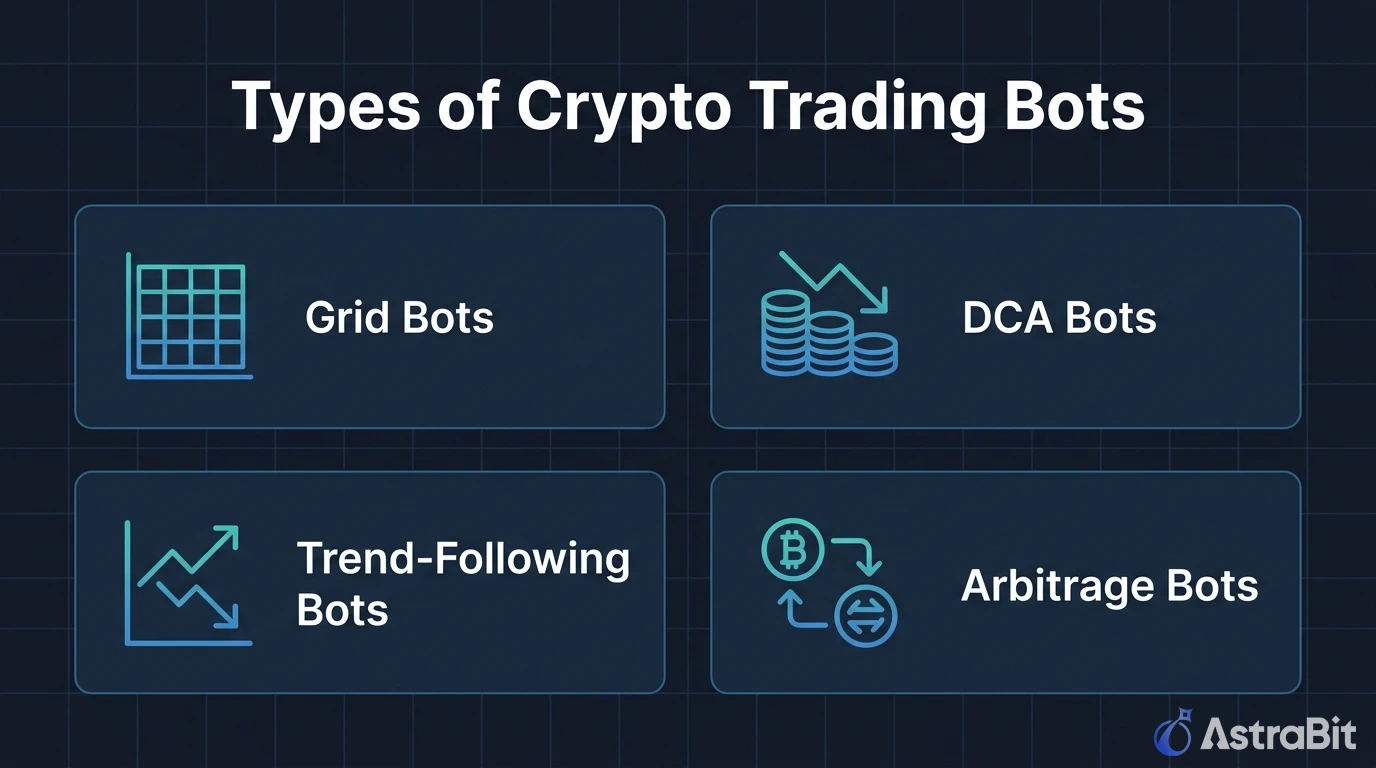
Not all trading bots behave the same way. Different approaches aim to capture different market structures and time horizons. Understanding these categories can help you choose strategies that better match your goals and risk tolerance.
Grid Trading Bots
Grid bots are typically designed for markets that are moving sideways within a range. They place a series of staggered buy and sell orders above and below the current price, attempting to capture repeated small moves as price oscillates.
- When price dips into a lower grid level, the bot buys.
- When price rises into an upper grid level, the bot sells.
Grid bots can be useful when price remains within a defined band, but they can struggle if the market breaks out strongly in one direction or if volatility changes suddenly. Managing grid spacing, position size, and total allocation becomes critical to avoid overexposure as conditions shift.
Dollar‑Cost Averaging (DCA) Bots
DCA bots spread entries over time or price levels rather than entering a position all at once.
For example, instead of buying a full position immediately, a DCA bot might:
- Buy a small amount each day or week.
- Add incrementally when price pulls back by a certain percentage.
This can help reduce the impact of short‑term volatility on entry price, though it does not protect against prolonged downtrends or structural changes in the asset. DCA bots are often used by traders who want a more systematic way to accumulate positions while avoiding the pressure of “perfect timing.”
Trend‑Following Bots
Trend‑following bots aim to participate in sustained moves up or down. They typically:
- Enter when certain trend criteria are met (for example, price above a moving average or a breakout level).
- Exit when trend conditions weaken or reverse.
These bots can perform well in strong directional markets but may experience frequent small losses in choppy, sideways conditions. Many traders add filters—such as minimum volatility thresholds or session‑based rules—to help decide when a trend is strong enough to participate.
Arbitrage Bots
Arbitrage bots look for price differences between venues or markets and attempt to capture those gaps. In practice, this can involve:
- Buying an asset where it is cheaper and selling where it is more expensive.
- Accounting for fees, slippage, and transfer costs.
While arbitrage opportunities can exist, they are often short‑lived and competitive. Execution speed, liquidity, and operational complexity matter significantly. Traders interested in arbitrage often focus as much on infrastructure and risk controls as they do on the strategy logic itself.
Pros of Crypto Trading Bots
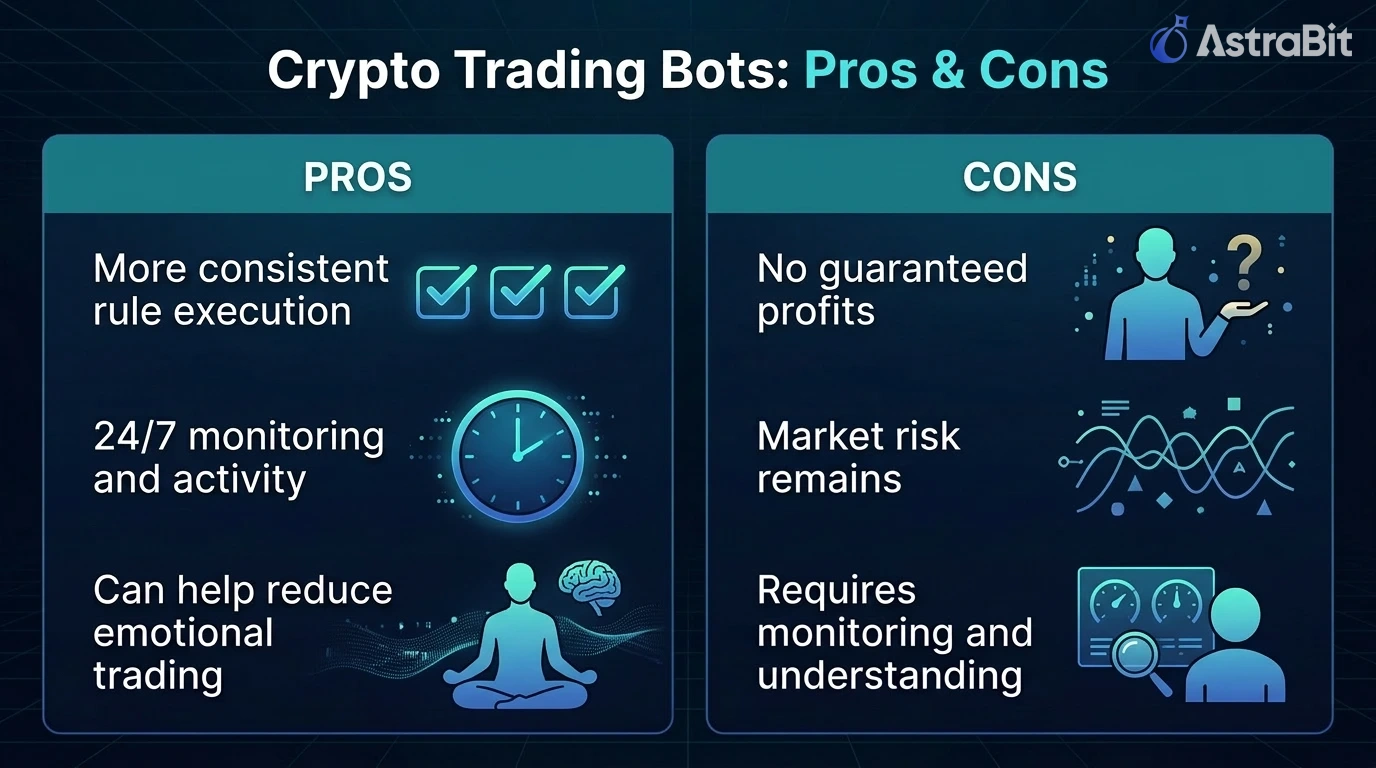
When used thoughtfully, crypto trading bots can support a more structured approach to trading.
Consistency
Bots follow predefined rules exactly. They do not second‑guess, hesitate, or deviate from the strategy unless you change it, which can help reduce impulsive decisions that drift away from a plan.
24/7 Execution
Crypto markets operate continuously. Bots can monitor and act at any hour, helping traders participate in moves that happen overnight or across multiple time zones without needing to be online constantly.
Reduced Emotional Trading
Fear, greed, and fatigue can influence manual decisions, especially after long sessions or during volatile periods. Bots execute predefined logic consistently, which may reduce emotional decision-making at the execution stage, but does not improve outcomes or eliminate risk, even though humans still design and adjust the strategy.
Efficiency and Scale
Bots can track multiple markets or strategies in parallel, something that is difficult for a single person to do manually. This can help traders manage more complex workflows from a central environment, particularly when they trade across several exchanges or asset classes.
Cons of Crypto Trading Bots
Trading bots are not without limitations. Understanding these trade‑offs is essential before using automation.
No Guaranteed Profits
A bot is only as effective as the strategy and settings behind it. If the logic is flawed or mismatched to the market, losses can occur, sometimes quickly. Automation can magnify both strengths and weaknesses of a strategy, so design and testing matter.
Market Risk Remains
Crypto assets are volatile. Sudden price moves, liquidity shifts, or structural changes in a venue can affect any strategy, automated or manual. Bots operate within that environment; they do not remove it, and they can be impacted by events such as gaps, de‑pegs, or protocol incidents.
Requires Understanding and Oversight
Even “pre‑built” or template strategies require:
- Configuration (position sizing, risk limits, assets, venues).
- Monitoring (to ensure the bot behaves as expected).
- Adjustment over time (when market conditions change).
Treating a bot as fully hands‑off can lead to surprises when markets behave differently than backtests or examples.
Over‑Optimization Risk
Strategies that appear strong in backtests or on historical data can perform differently in live markets. Over-fitting to past conditions—by tuning parameters too tightly to prior price behavior—can make a strategy fragile when the environment shifts, even slightly.
Key Risks When Using Crypto Trading Bots
A clear view of risk is important for any trading activity, and automation is no exception.
Market Volatility
Rapid price changes can impact strategies that depend on tight ranges or gradual moves. Stop levels can be skipped, and order execution can occur at less favorable prices during high volatility, especially in thinly traded markets.
Strategy Misconfiguration
Incorrect parameters, such as size, leverage (where applicable), or thresholds, can lead to unintended positions or exposures. Small configuration errors can be amplified when executed automatically and repeatedly.
API and Security Considerations
Using bots typically involves creating API keys with your exchange. It is important to:
- Restrict permissions (for example, trading only, no withdrawal, where supported).
- Store keys securely and rotate them when needed.
- Use platforms that prioritize security and transparency around how keys are handled.
Unrealistic Expectations
Perhaps the most significant risk is mindset. If bots are approached as guaranteed income or as a replacement for understanding, users can over-allocate, under‑monitor, and be surprised by normal drawdowns. Viewing bots as part of a broader process, rather than as a complete solution on their own, tends to produce more sustainable use.
Are Crypto Trading Bots Profitable?
A common question is whether crypto trading bots “work” or are “profitable.” The honest answer is that they can be, but outcomes vary widely and are never guaranteed.
Profitability depends on factors such as:
- The underlying strategy design.
- Market regime and volatility.
- Risk management and position sizing.
- How actively the user monitors and adjusts.
No strategy, manual or automated, wins all the time. Drawdowns, periods of under-performance, and unexpected outcomes are part of trading. The role of a bot is to help execute a plan consistently, not to remove uncertainty from the market or to ensure specific returns.
How to Get Started with Crypto Trading Bots
For traders who are new to automation, it is often helpful to start with a simple, structured approach.
Step 1: Learn the Basics
Understand the fundamentals of:
- Market behavior and volatility.
- Core strategy types (for example, trend‑following, DCA, grid).
- Risk concepts such as drawdown, position sizing, and diversification.
Even a basic grounding can make it easier to evaluate whether a given bot or template aligns with your goals.
Step 2: Choose a Platform
Look for platforms that emphasize:
- Transparency around how bots work and what they can and cannot do.
- Clear strategy controls rather than opaque “black box” promises.
- Support for the venues and assets you actually use.
- Educational resources and documentation to help you understand configurations.
Step 3: Connect Your Exchange
Most platforms use API connections to link to centralized or decentralized venues. Follow best practices for key permissions and security, and verify connections with small tests before deploying larger allocations.
Step 4: Start Small
Begin with modest position sizes while you:
- Learn how configurations behave.
- Observe how strategies respond to real‑time conditions.
- Build comfort with the workflow and monitoring cadence.
Step 5: Monitor and Adjust
Automation is not the same as neglect. Reviewing performance, adjusting parameters, and pausing or changing strategies when needed are all part of responsible use. Many traders schedule regular check‑ins, even for long‑running systems, to ensure the current approach still fits the current market.
What to Look for in a Crypto Trading Bot Platform
Choosing a platform is about more than just features. It is about alignment with how you want to trade and how you think about risk.
A thoughtful platform typically offers:
- Clear strategy control: The ability to configure, review, and understand the logic behind each bot, instead of relying solely on opaque labels or marketing names.
- Transparent performance tracking: Access to trade history, metrics, and portfolio‑level views, so you can see how automation fits into your broader exposure.
- Risk management tools: Allocation limits, guardrails, and ways to monitor exposure across strategies and venues, rather than managing each bot in isolation.
- Secure integrations: Robust handling of API keys and connections to exchanges, with clearly documented practices.
- Educational support: Guides, explanations, and content that focus on understanding and process, not just outcomes.
Platforms that anchor on realistic expectations and education tend to be better suited to long‑term use than those that focus primarily on promotional claims or short‑term results.
Where AstraBit Fits In
When traders think about “the ideal trading bot platform,” they often describe a few consistent themes: multi‑exchange access, structured automation, portfolio visibility, and a clear distinction between tools and promises. AstraBit was built with those themes in mind.
AstraBit is a multi‑exchange trading technology platform that connects users to both centralized (CEX) and decentralized (DEX) exchanges within a single environment. It is designed to support:
- Automated strategies and manual trading side‑by‑side.
- Portfolio analytics and performance visibility across connected accounts.
- Access to DeFi components and tokenization modules through AstraBlox as they are introduced.
Rather than positioning bots as a shortcut, AstraBit focuses on:
- Helping users design structured workflows that combine automation and discretion.
- Providing tools for allocation, monitoring, and review at both strategy and portfolio levels.
- Operating with a regulatory‑first mindset in areas where broker‑dealer activity is involved, while clearly distinguishing non‑regulated digital asset services.
In practice, this means traders can:
- Connect to multiple CEXs and supported DEXs from one dashboard.
- Run bots that execute predefined logic on top of those venues.
- Use analytics to understand how strategies contribute to overall exposure and behavior, without viewing them in isolation.
Automation remains a tool. AstraBit’s role is to help organize that tool within a broader, more transparent trading process—so traders can pursue structured, multi‑venue workflows without giving up visibility or control.
FAQs
Are crypto trading bots legal?
In many jurisdictions, using trading bots is permitted, but rules can vary by region and by platform. Users are responsible for understanding the legal and tax implications that apply to their own situation.
Do crypto trading bots really work?
Bots can execute strategies as designed, but results depend on the underlying logic, market conditions, and risk management. No bot can guarantee profits or avoid losses.
Can beginners use trading bots?
Yes, but it is important for beginners to start with simple strategies, small allocations, and a focus on learning how automation behaves before scaling.
How much money do I need to start using a bot?
There is no universal minimum. Some users begin with small amounts to test connectivity, slippage, and strategy behavior, then adjust based on experience and risk tolerance.
For details on how our own plans are structured, you can review AstraBit pricing and plans.
Are trading bots safe?
Bots can be used in a way that aligns with a user’s risk tolerance when combined with secure platforms, restricted API permissions, and thoughtful configuration. However, market risk, technical risk, and configuration risk remain.
Do professional traders use bots?
Automation and systematic execution are widely used in professional trading. The specific tools and methods vary, but the underlying idea—using rules to standardize parts of the workflow—is common across many market participants.
Related Concepts
If you are exploring crypto trading bots, the following topics are closely connected:
- Centralized vs. Decentralized Crypto Exchanges: Making an Informed Choice with AstraBit
- Trading across centralized and decentralized exchanges.
- Web3 super apps and multi‑service platforms for digital assets.
These areas can help provide useful context as you evaluate whether, and how, automation fits into your overall approach to markets.
Disclosure
Disclosure: This communication is for informational purposes only and is not an offer to buy or sell any security or digital asset, nor should it be considered financial, investment, tax, or trading advice. Digital assets are speculative and involve a high degree of risk; you may lose some or all of your investment. Not all AstraBit services are broker-dealer services, nor are they regulated by the SEC or FINRA. Other services may involve non-regulated digital assets and do not receive the protections applicable to regulated activities, including, but not limited to, the investor protections offered by SIPC. Past performance, including hypothetical or back-tested results, does not guarantee future results, and AstraBit makes no guarantee of profit or return. You should consult a licensed financial professional before making any investment decision or relying on AstraBit products or services. AstraBit operates through CPT Capital LLC (d/b/a AstraBit, AstraBlox, and AstraEx), a U.S. Broker-Dealer registered with the SEC and a FINRA member. For more information, visit FINRA BrokerCheck (https://brokercheck.finra.org/) and use CRD #331540.
Share this post


Related Posts

What Is a Web3 Super App? Meaning, Examples, and How It Works
A Web3 super app is a platform that combines multiple blockchain-based services, such as wallets, trading, and decentralized applications, into a single interface. Breaking Down What a Web3 Super App Really Means, Why It Exists, and Where AstraBit Comes In If you have spent any time around digital assets, blockchain, or crypto‑related news, you may […]

Cam Paulding
23 Feb 2026 • 17 min read

Automated Crypto Trading: How AstraBit Bridges CEX and DEX
Automated Crypto Trading, Re-imagined: How AstraBit Bridges CEX and DEX Trading Crypto trading often feels like a balancing act. Traders must choose between platforms that support centralized exchanges (CEXs) or decentralized ones (DEXs), weighing convenience against control, and automation against oversight. AstraBit was created to help streamline that experience. It enables users to automate trades […]
Cam Paulding
03 Feb 2026 • 8 min read
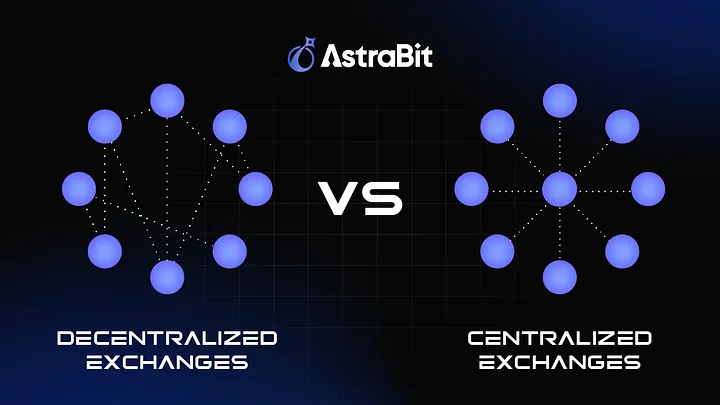
Centralized (CEX) vs Decentralized (DEX) Exchanges
Centralized vs. Decentralized Crypto Exchanges: Making an Informed Choice with AstraBit In the rapidly evolving world of cryptocurrency, choosing the right exchange is one of the most critical decisions a trader can make. The choice between Centralized Exchanges (CEXs) and Decentralized Exchanges (DEXs) is more than just a technical one — it’s a reflection of […]
Cam Paulding
26 Oct 2025 • 5 min read