
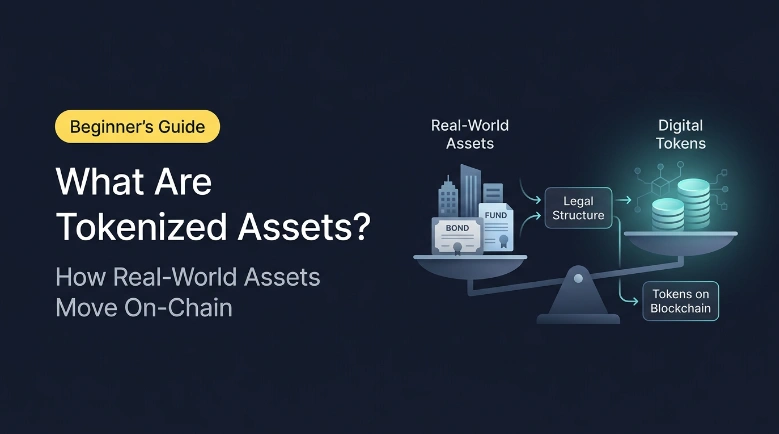
Tokenized assets are digital tokens that represent rights to underlying assets such as real estate, funds, or bonds, using blockchain infrastructure to record and transfer ownership. They use blockchains or similar ledgers to record and transfer those rights in a standardized, programmable way.
What Are Tokenized Assets?
Tokenized assets are digital tokens on a blockchain that represent rights to something else, rather than existing as standalone assets with no external reference. Each token is linked by legal agreements and documentation to a specific underlying asset or pool of assets, such as a property, a loan portfolio, or units in a fund. The blockchain provides a shared record of which addresses hold which tokens, while traditional records describe what those token holdings actually mean in legal and economic terms.
Instead of tracking ownership only in registries, spreadsheets, or institution‑specific systems, tokenized assets add a blockchain‑based record that can be divided into smaller units, transferred between addresses, and settled using the same infrastructure as other digital tokens. This can make it technically easier to fractionalize interests, automate certain processes with smart contracts, and integrate ownership data across platforms and services. In practice, the underlying asset usually remains in traditional custody or legal structures, while the token provides a standardized digital representation on top.
Tokenization comes up frequently in conversations about “real‑world assets,” on‑chain finance, and how existing markets might evolve. In many cases, tokenization does not change what the asset is or the core regulatory framework; it changes how records are kept, how transactions are processed, and how easily positions can be divided or moved between compatible systems. This article explains how tokenized assets work at a high level, where they are being explored today, and the main benefits, limitations, and risks to be aware of, in an educational and product‑neutral way.
A tokenized asset is a digital token that records ownership or other rights linked to a specific underlying asset, such as a security, loan, fund interest, or physical item.
The underlying asset and investor rights are defined in legal agreements and traditional records; the token is a digital representation of those rights on a blockchain or similar ledger.
Tokenization can make it technically easier to divide ownership into smaller units, transfer interests, and settle transactions using shared digital infrastructure.
The process is complex, and outcomes depend on legal structure, regulation, technology choices, and risk controls—not just on creating a token.
What is Asset Tokenization?
n simple terms, tokenized assets are digital tickets for rights. Each token represents a claim defined somewhere else—such as a share in a company, a unit of a fund, a slice of a loan, or an interest in a property. The blockchain acts as a public list of who holds which tickets, while traditional legal agreements explain what each ticket actually entitles the holder to receive.
Examples that come up in practice and in public discussions include:
- Tokenized shares or fund units
- Tokenized bonds or other debt instruments
- Tokenized interests in real estate or infrastructure
- Tokenized claims on commodities or inventories
- Tokenized revenue‑sharing or royalty rights
The key point is that the value of the token depends on the underlying asset and the legal structure behind it, not just on supply and demand for the token itself.
How Tokenized Assets Work (Simple Overview)
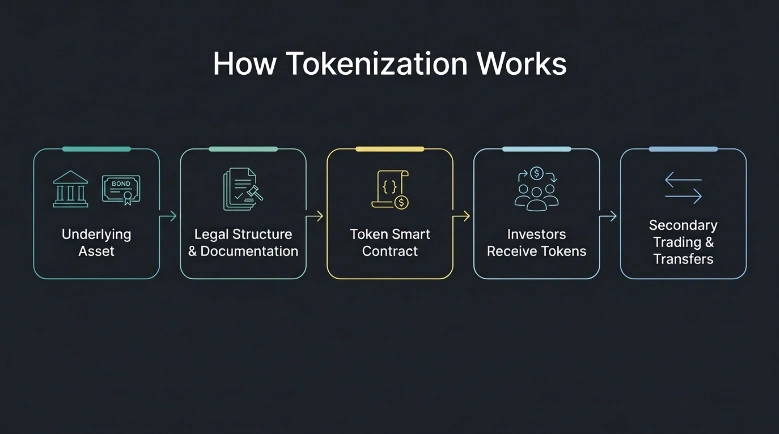
The details vary by jurisdiction and asset type, but many tokenization workflows share a few common steps.
1. Choose the asset and structure
A sponsor or issuer identifies an asset or pool of assets—such as a loan portfolio, a fund, or a property—and chooses how to hold it legally. Often, this involves a company, trust, fund, or other legal vehicle that owns or controls the asset and issues claims to investors.
2. Define investor rights and documentation
Legal agreements describe what token holders are entitled to, such as cash flows, voting rights, or redemption terms. These documents usually specify the relationship between the token and the underlying asset (for example, “one token represents one share in this entity”).
3. Create and configure the tokens
Tokens are created on a chosen blockchain or distributed ledger using smart contracts or similar mechanisms. The contract can encode basic rules about how tokens move—for example, transfer restrictions, whitelists, or how many tokens exist in total.
4. Distribute tokens to investors
Tokens are allocated or sold to investors according to the chosen offering process, which may involve regulated placements, on‑platform subscriptions, or other distribution channels. On-boarding steps such as identity verification, eligibility checks, and documentation still apply where required by law.
5. Trade, transfer, and manage over time
After issuance, tokens can be held, transferred, or traded on venues that support them, subject to applicable rules and market demand. Asset servicing—for example, interest payments, redemptions, or corporate actions—continues according to the underlying legal structure, and may be reflected by updating token balances or associated records.In many cases, the underlying asset itself stays in traditional custody, while the token is a digital representation that makes certain operations easier to automate or standardize.
Tokenized Assets vs Other Digital Assets
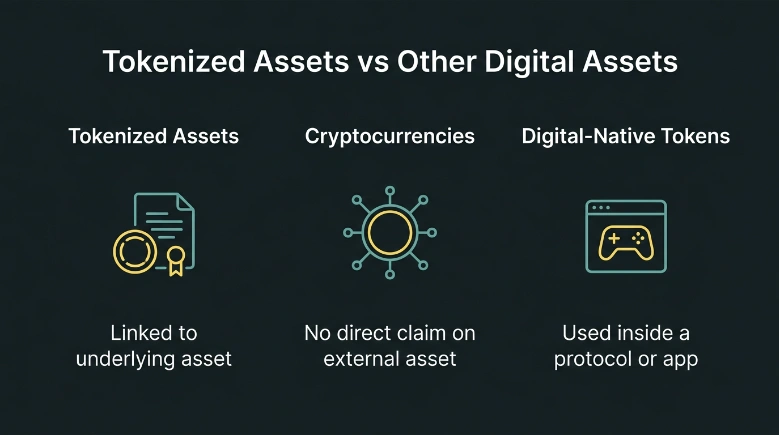
It can be helpful to distinguish tokenized assets from other types of tokens people encounter.
Tokenized assets vs cryptocurrencies
- Tokenized assets derive their value from an underlying asset or pool of assets and from the legal rights attached to the token.
- Cryptocurrencies such as Bitcoin are typically not claims on a separate asset; their value depends mainly on market demand and network properties.
Tokenized assets vs purely digital‑native tokens
Some tokens are used purely within a protocol or game and are not meant to represent claims on external assets. By contrast, tokenized assets are explicitly tied to off‑chain rights that are described in legal documents.
Tokenized assets vs traditional book‑entry securities
Traditional securities are recorded in registries, transfer‑agent systems, or central securities depositories. Tokenized securities may use similar legal frameworks but add a blockchain layer for representing and transferring positions, sometimes with faster settlement cycles and different operating models.
Why Are Tokenized Assets Being Explored
Public discussions and research often highlight several potential benefits of tokenization.
Fractional interests and access
Because tokens can be created in small units, tokenization can make it technically easier to represent fractional interests in higher‑value assets, such as properties or funds. This may allow more flexible minimum investment sizes, depending on regulation and platform design.
Standardized, programmable infrastructure
Using shared ledger infrastructure can make ownership records easier to integrate across systems and may allow certain actions—such as distributions or redemptions—to be automated through smart contracts.
Faster and more flexible settlement
Token transfers can often be settled on a near‑real‑time basis, especially when both sides of the transaction use the same digital asset rails. This can reduce some types of settlement risk and may simplify certain workflows.
Transparency and auditability
Blockchain‑based records can provide a clear transaction history and real‑time visibility into token balances, subject to how the system is designed. However, transparency at the token level does not automatically reveal full details about the underlying assets or legal arrangements.
These potential advantages are still being tested in practice, and results can differ across projects and markets.
Examples People Use to Explain Tokenization
Public explainers and community discussions often rely on a few concrete examples to make tokenization easier to picture.
- Real‑estate interests – A company or trust owns a building, and tokens represent shares or debt claims linked to that entity. Rental income and sale proceeds are handled according to legal agreements, with tokens serving as the digital representation of investor interests.
- Bonds or loans – A series of interest‑bearing obligations is recorded in legal documents, and tokens track who holds each unit of exposure.
- Funds and pooled vehicles – A fund holds a portfolio of assets, and tokens represent units of the fund, similar in concept to existing fund shares but using different technology for record‑keeping and transfer.
Community threads often describe tokenization as “turning ‘I own X / I am owed Y’ into digital tickets recorded on a public list,” with the understanding that the legal documents define how those tickets relate to the real asset.
Considerations and Risks
Alongside potential benefits, tokenized assets introduce important considerations.
Legal structure and investor protections
The legal framework behind a tokenized asset—such as how ownership is defined, what rights token holders have, and how disputes are handled—plays a major role in the outcome. Tokens with similar technology can behave very differently depending on how the underlying structure is set up.
Operational and technology risk
Tokenization platforms, smart contracts, and integration points can introduce new operational and security risks. These include software bugs, key‑management challenges, and dependency on specific service providers or networks.
Market and liquidity risk
Tokenization can make it technically easier to trade or transfer positions, but it does not guarantee that there will be active buyers and sellers. Liquidity still depends on investor interest, market conditions, and the venues where the tokens are available.
Regulatory and tax considerations
Tokenized assets often touch multiple regulatory frameworks—for example, securities law, payments rules, and local tax regimes. Requirements differ across jurisdictions and may evolve over time, which can affect how these products are offered, who can invest, and how transactions are reported.
As with any financial or technological development, it can be useful to consider these factors carefully and seek professional guidance where appropriate.
Summary
Tokenized assets are digital tokens that represent rights to underlying assets, recorded on blockchains or similar ledgers. They aim to combine familiar legal and financial structures with shared digital infrastructure that can support more flexible ownership, transfer, and settlement. Potential benefits include easier fractionalization, more standardized record‑keeping, and faster settlement, but actual outcomes depend heavily on legal design, regulation, technology choices, and risk management.
FAQs About Tokenized Assets
Are tokenized assets the same as cryptocurrencies?
No. Many tokenized assets are designed to represent claims on specific underlying assets, while cryptocurrencies like Bitcoin generally do not represent a claim on a separate asset.
Can tokenization make an illiquid asset instantly liquid?
Not necessarily. Tokenization can make it technically easier to divide and transfer interests, but liquidity still depends on investor demand, available venues, and applicable rules.
Do token holders always have legal ownership of the underlying asset?
It depends on the structure. In some cases, tokens represent direct ownership interests; in others, they represent contractual claims on an entity that holds the asset. The legal documentation, not the token alone, defines those rights.
Are tokenized assets risk‑free because they use blockchain technology?
No. Tokenized assets can carry market, credit, operational, technology, and legal risks, just like other financial products. Blockchain infrastructure introduces additional factors, such as smart‑contract and key‑management risk.
Can anyone invest in tokenized assets?
Access depends on the specific product and jurisdiction. Some tokenized offerings are limited to certain types of investors or regions due to regulatory and platform policies.
Related Concepts
- What Is Cryptocurrency?
- What Is Web3?
- How Do You Tokenize an Asset?
- What Are Gas Fees?
- What Is a Web3 Wallet?
Disclosure
This material is provided for educational and informational purposes only and is not intended to promote or recommend any specific product, service, platform, or strategy. The information contained herein is provided “as is,” without any representations or warranties of any kind, express or implied, including without limitation any warranty as to accuracy, completeness, timeliness, or materiality. Nothing in this material should be construed as financial, investment, legal, tax, or other professional advice, and you should not rely solely on it when making decisions. Some or all of the content, including any edits or revisions, may have been generated or assisted by artificial intelligence tools and may contain errors or omissions. The authors and publishers of this material disclaim any and all liability arising from the use of or reliance on this information.