
A decentralized exchange (DEX) is a type of crypto exchange that runs on a blockchain and lets you trade directly from your own wallet. Instead of depositing assets with a company that manages an internal order book, you interact with smart contracts that track balances, manage an order book, and apply trading rules.
What Is a Decentralized Exchange (DEX)? How On‑Chain Trading Works
Decentralized exchanges are a core part of crypto markets, but they operate differently from traditional brokerages or centralized exchanges. Instead of opening an account on a company website, you connect a wallet and interact with an exchange that lives on‑chain.
This guide explains what a decentralized exchange is, how trading on a DEX works, and the potential benefits, limitations, and risks. It is for education only and is not a recommendation to use any particular platform or strategy.
A decentralized exchange (DEX) is a crypto trading venue built using smart contracts on a blockchain, where you trade from your own wallet by funding an on‑chain trading account instead of depositing into a centralized account.
Many DEXs use on‑chain or hybrid order books to let you place buy and sell orders on trading pairs like BTC/USDC or ETH/USDT, with familiar order types such as market, limit, and stop orders when supported.
DEXs can offer self‑custody, permissionless access, and on‑chain transparency, but they also introduce specific risks, including smart‑contract failures, liquidation risk on leveraged products, front‑running, and irreversible wallet mistakes.
Using a DEX safely requires comfort with wallets, gas fees, and on‑chain transactions, as well as an understanding that you can lose money through technical issues or contract behavior—not just market volatility.
How Trading on a DEX Works
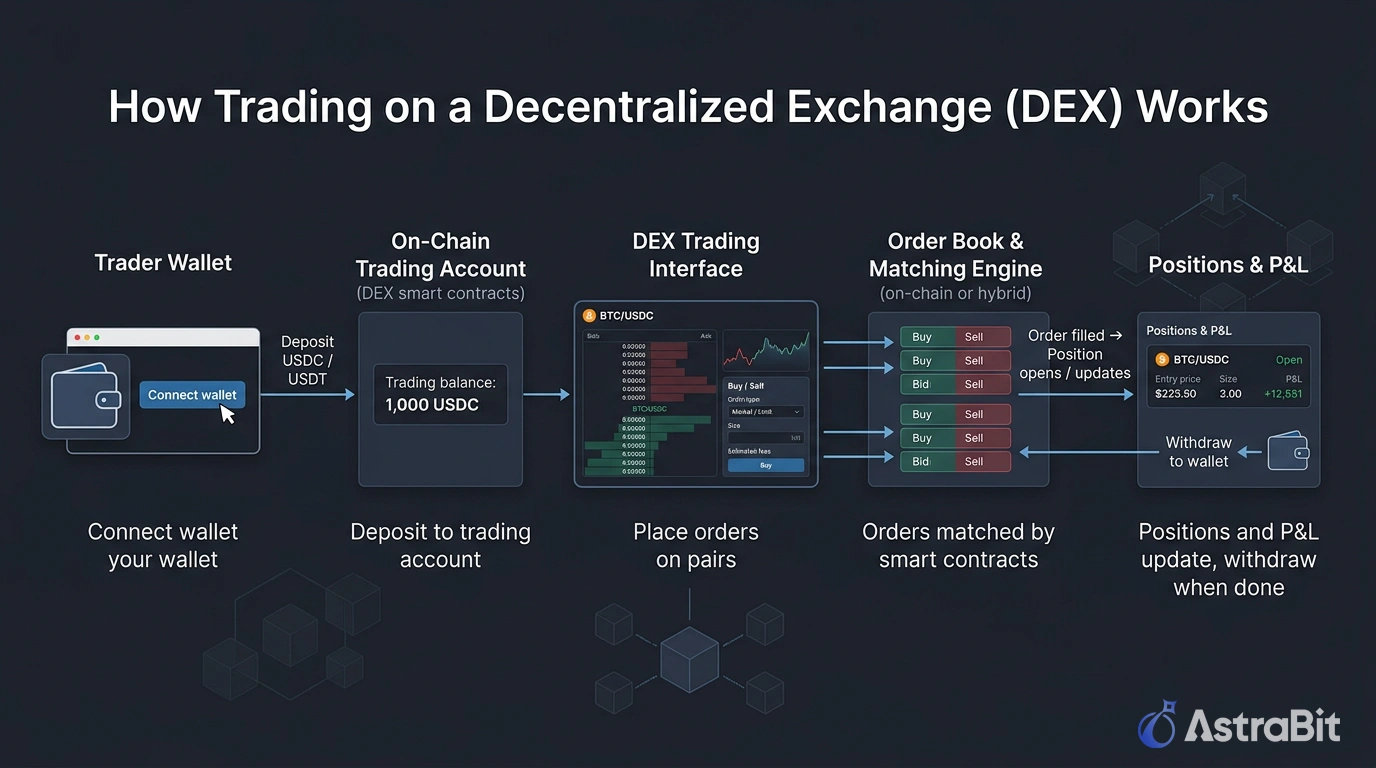
Trading on a decentralized exchange functions like trading on a crypto exchange, but the matching, balances, and rules are handled by smart contracts and decentralized infrastructure instead of a centralized company. You connect a wallet, fund an on‑chain trading account, select markets such as BTC/USDC or SOL/USDT, and place orders that move your positions and P&L.
1. Connect Your Wallet
You go to the DEX interface and connect a compatible web3 wallet, such as a browser extension or mobile wallet. The connected wallet address is your trading identity on the exchange; there is typically no separate username and password system.
2. Deposit Assets Into Your Trading AAccount
Through the DEX’s UI, you deposit a base asset (for example, USDC or USDT) from your wallet into the exchange’s smart contracts. This funds your on‑chain trading account, similar in concept to depositing into a centralized exchange, but your balance is tracked and enforced by contracts instead of a private company database.
NOTE: There are typically ‘gas fees’ involved with depositing funds on to a DEX.
3. Select a Trading Pair
Inside the DEX, you choose the trading pair you want to trade, such as BTC/USDC, ETH/USDC, or SOL/USDT. The interface typically shows an order book, recent trades, your available balance or margin, and any open positions you already have in that market.
4. Choose Order Type and Size
You decide whether to buy or sell and pick an order type supported by the DEX—usually market and limit orders, or leveraged orders. You then enter either how much base asset you want to spend (for example, 1,000 USDC) or how much of the top asset you want to buy or sell (for example, 0.1 BTC), and the DEX shows you the estimated fill based on the current order book.
5. Submit the Order To The Exchange
When you confirm, the order is sent to the DEX’s infrastructure, which may use a fully on‑chain order book, an off‑chain book with on‑chain settlement, or a hybrid model. Your order appears in the book and can be matched against opposing orders according to the exchange’s rules, often using price‑time priority similar to centralized venues.
6. Positions Open, Update, and Close
Once your order is filled, you hold a position in that market, which can be spot or, on some DEXs, a leveraged or perpetual derivatives position. You can add size, reduce size, place take‑profit and stop‑loss orders, or manually close the position, subject to available liquidity and margin rules.
7. Account Balance and P&L
As prices move, your unrealized profit and loss changes, and realized P&L, fees, and any funding or interest payments are reflected in your DEX trading account balance. When you are done trading, you withdraw assets from the DEX’s contracts back to your wallet through an on‑chain transaction, similar in concept to withdrawing from a centralized exchange but without involving a custodial back office.
NOTE: There are typically ‘gas fees’ involved with withdrawing funds off a DEX.
In this model, you still think in terms of pairs, orders, positions, and P&L. The difference is that those mechanics are enforced by smart contracts and decentralized components instead of a centralized matching engine and internal ledger.
How a DEX Actually Runs (Under the Hood)
Behind the trading interface, a decentralized exchange is a coordinated set of smart contracts and services that handle balances, order management, matching, and settlement. The goal is to recreate familiar exchange behavior while relying on on‑chain enforcement rather than a single operator.
On‑Chain Trading Accounts and Balances
When you deposit funds:
- The assets move from your wallet into smart contracts that record balances for each trading address.
- These balances serve as your collateral or spot funds for placing orders and holding positions.
- The contracts enforce basic rules, such as not allowing you to place orders that exceed your available balance or margin requirements.
In some designs, balances are fully on‑chain at all times; in others, a combination of on‑chain proofs and off‑chain data structures is used to track balances efficiently.
Order Books and Matching Engines.
Order‑book DEXs maintain buy and sell orders for each trading pair and match them when prices cross.
- In a fully on‑chain design, orders and cancellations are posted as transactions, and matching is handled directly in contracts, with settlement occurring when blocks are produced.
- In hybrid designs, an off‑chain service maintains the live book and matching engine, but actual settlement—updating balances and positions—happens on‑chain under contract rules.
In both cases, the matching logic aims to follow predictable rules, such as price‑time priority, while leaving final state changes under contract control.
Positions, Margin, and Liquidation Logic
For DEXs that support leveraged or perpetual markets:
- Smart contracts track open positions, not just simple spot balances, including size, entry price, and collateral.
- The system calculates margin requirements and monitors prices to determine when positions should be liquidated or adjusted.
- If a position’s losses exceed allowed limits, liquidation logic closes it—typically by selling into the book—to protect the shared pool of collateral or counterparties.
All of this behavior is dictated by parameters encoded in contracts or associated systems, rather than by discretionary decisions from a centralized risk desk.
Settlement and Block Producers
Once transactions are submitted:
- They enter the network’s transaction pool and wait to be included in a block by block producers or validators.
- When a block is produced, the chain executes the DEX smart contracts’ logic, updating balances, positions, and order status according to the defined rules.
- The ordering of transactions within a block can affect which orders fill first and the prices at which they execute, which is why transaction ordering and network design matter.
Because this activity is on‑chain, anyone can inspect the final state and verify that the contracts behaved as specified, but users are also exposed to risks around transaction ordering and network congestion.
DEX vs. Centralized Exchange (CEX): How They Differ
While both decentralized and centralized exchanges let you trade crypto assets, they differ in who controls funds, how orders are matched, and what happens when things go wrong.
Custody
- On a CEX, you deposit assets to an account the exchange controls; your balance is tracked on the exchange’s internal ledger. You hand over your claim on the crypto to the CEX account, until you withdraw the funds back into your possession.
- On a DEX, you fund an on‑chain trading account controlled by smart contracts and typically keep the rest of your assets in your own wallet. While the smart contract holds your crypto assets that you deposit, there are ways to manually remove those funds if needed. We will cover that later in the article.
Access
- CEXs generally require identity verification and may limit access based on jurisdiction or other policies.
- DEXs are generally open to compatible wallets that can pay network fees, though front‑end interfaces may still restrict use for certain regions or users.
Execution and speed
- CEXs use internal matching engines that can update balances instantly on their own systems.
- DEX trades finalize on‑chain, so speed and confirmation depend on network conditions and block times.
Fees
- CEXs charge trading and sometimes withdrawal fees, set by the operator.
- DEX users pay exchange trading fees, when applicable, plus blockchain network fees, which can be significant during congestion.
Support and recovery
- CEXs may offer customer support and limited mechanisms for addressing account or transaction issues.
- DEXs generally do not provide direct recourse if you make a mistake in a transaction or interact with the wrong contract; outcomes follow the chain’s rules.
Neither model is inherently better for every situation; each aligns with different preferences and constraints.
What People Use DEXs For
People use decentralized exchanges for several reasons, often overlapping:
Trading from self‑custodied wallets
Users who prioritize control over their keys may prefer to trade through DEXs rather than leaving assets with a centralized custodian.
Accessing a wider range of assets and markets
Newer or more specialized assets and perpetual markets often appear on DEXs before being listed on large centralized exchanges, which can increase both opportunity and risk.
Participating in on‑chain strategies
Because DEXs live on‑chain, other applications can interact with them programmatically, enabling strategies for re-balancing, hedging, or collateral management that depend directly on‑chain execution.
Providing liquidity or collateral
Some users provide assets as liquidity or collateral to earn fees or incentives, a distinct activity from trading that introduces additional contract and market risks.
Potential Benefits and Limitations of DEXs
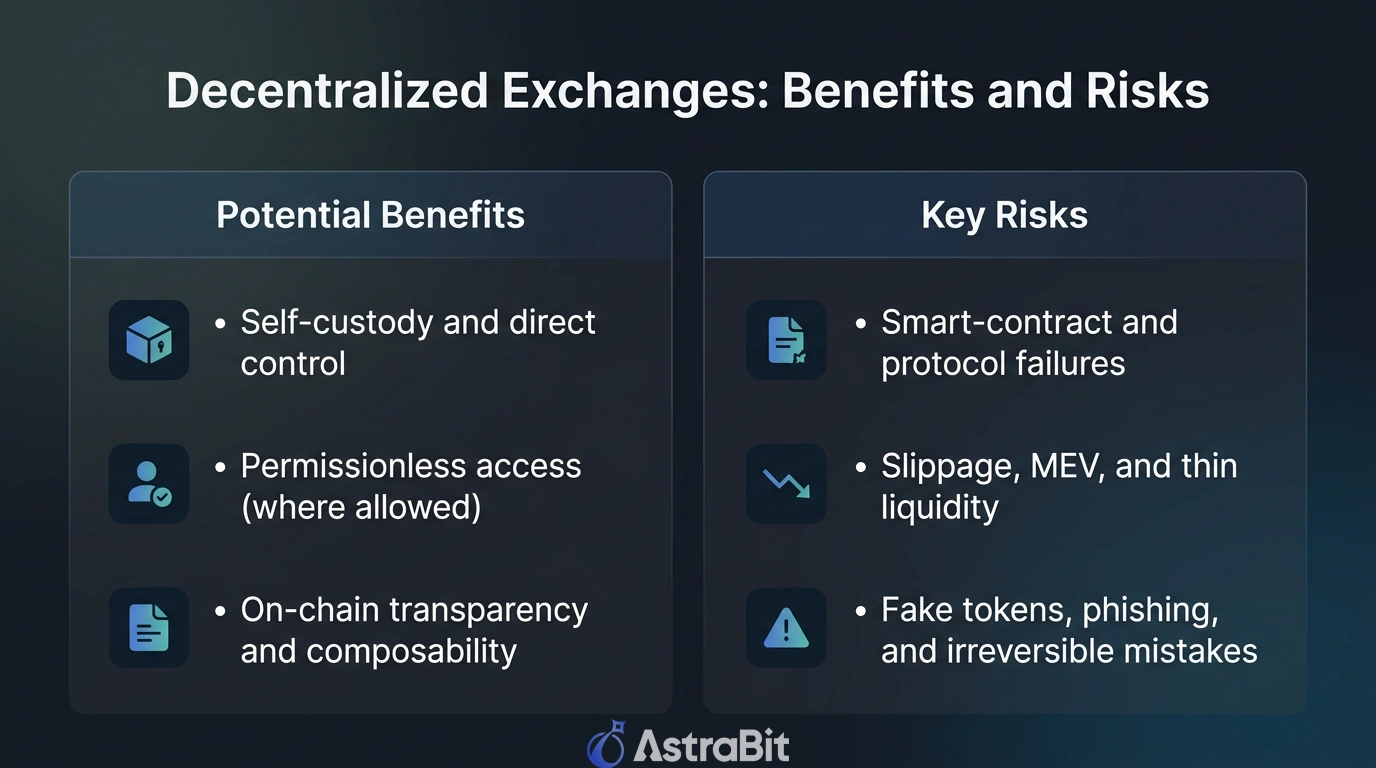
Potential Benefits
Self‑custody and Control
You can trade without placing all assets in a centralized account, which can reduce certain custodial and counterparty risks while increasing your responsibility for security.
Unverified Access (Where Allowed)
Many DEXs can be accessed with only a compatible wallet and network fees, subject to any local legal or policy restrictions.
On‑Chain Transparency
Balances, many fees, and settlement events are visible on the blockchain, allowing anyone to inspect how the exchange operates at the contract level.
Composability
Other on‑chain applications can integrate DEXs, which allows more complex products and workflows to build on existing liquidity and exchange logic.
Limitations and Trade‑Offs
Complexity and User‑Error Risk
Managing wallets, network fees, and contract interactions introduces more ways to make irreversible mistakes, such as sending funds to the wrong address or interacting with an impostor contract.
Network Fees and Congestion
When blockchains are busy, fees can rise, and transactions may be delayed or fail, impacting trading and risk management.
Execution Quality and Ordering Effects
Slippage, partial fills, and transaction ordering can affect the price you receive, especially in thin markets or during sharp moves.
Reliance on Code and Parameters
Outcomes depend on smart‑contract logic and configuration. Bugs, design flaws, or unintended interactions can affect exchange behavior for all users.
The same characteristics that make DEXs flexible and transparent can also make them unforgiving when something goes wrong.
Key Risks When Using a DEX
Smart‑Contract Risk
Decentralized exchanges run on smart contracts, and if those contracts contain bugs or vulnerabilities, funds held by the exchange can be stolen or locked. Audits and reviews can help reduce risk but cannot guarantee safety, and even widely used projects have seen contract‑level issues.
Technical and Wallet Risk
To use a DEX, you usually manage your own wallet and signing:
- Losing a recovery phrase or private key can mean permanent loss of access to assets.
- Storing keys insecurely can allow others to take control.
- Signing transactions or approvals without understanding them can grant broader access than intended.
In many cases, there is no way to reverse these kinds of errors once they occur on‑chain.
Price, Liquidation, and Ordering Risk
On DEXs, market behavior and protocol rules can combine in ways that affect outcomes:
- Large orders or illiquid markets can lead to poor fills or difficulty exiting positions.
- On leveraged DEXs, rapid price moves can trigger liquidations if margin requirements are not maintained.
- Public transaction queues and block‑level ordering can affect the timing and prices of fills.
These are features of operating in transparent, permissionless markets and should be considered part of the risk profile.
Fake Assets, Spoofed Interfaces, and Phishing
On many networks:
- Anyone can deploy a token with a familiar ticker or name, and malicious contracts can impersonate known assets.
- Fraudulent websites can copy the look of popular DEX interfaces while routing transactions to attacker‑controlled contracts.
- Phishing attempts can trick users into revealing recovery phrases or signing harmful transactions.
Verifying contract addresses, using trusted links, and treating unsolicited messages with skepticism are basic but important steps.
Regulatory and Tax Considerations
Regulatory and tax rules for digital assets and on‑chain trading vary across jurisdictions and continue to evolve. Using a DEX does not remove legal or reporting obligations; you may be responsible for tracking activity and reporting gains, losses, or income under applicable law.
Is a DEX Right for You?
Before deciding whether to use a decentralized exchange, it may help to ask:
- Am I comfortable managing a self‑custodied wallet and keeping recovery information secure?
- Do I understand that contract behavior, technical issues, and my own transaction decisions can cause losses in addition to normal market risk?
- Can I interpret basic on‑chain information about balances, confirmations, and fees, or am I prepared to learn?
- How would an unexpected loss on a DEX affect my broader financial situation?
This article is informational and does not recommend using or avoiding any specific exchanges. For guidance tailored to your situation, consider speaking with qualified professionals who understand your circumstances and local rules.
FAQs
Do DEXs hold my funds?
DEXs hold assets and collateral in smart contracts and track trading balances on‑chain, but there is usually no personal custodial account at a company in your name. You typically keep broader holdings in your own wallet and only deposit what you intend to trade or use as collateral.
Is trading on a DEX anonymous?
Most public blockchains are pseudonymous: addresses and transactions are visible, but they do not include real names by default. However, activity can often be linked to real‑world identities through other data or service providers.
Why do I pay network fees when using a DEX?
Each interaction with a DEX is a transaction on the underlying blockchain, and network fees compensate block producers or validators for processing it and executing the exchange’s contract logic.
Can I lose money providing liquidity or collateral to a DEX?
Yes. In addition to price movements, liquidity providers and collateral suppliers face contract risk, liquidation risk on leveraged products, and the possibility that returns differ from simply holding the underlying assets.
What happens if the DEX website is unavailable, or a DEX shuts down?
As long as the underlying contracts remain deployed, other interfaces or tools can interact with the DEX, but using it without a reliable front end can be difficult for many users. The availability and quality of alternative interfaces vary by project.
What are gas fees?
Gas fees are charges paid to process transactions on a blockchain. They compensate validators or miners for including transactions in a block and executing the underlying smart contract logic. Gas fees can vary based on network demand, transaction complexity, and the blockchain being used.
Key Terms Glossary
- Decentralized exchange (DEX) – A crypto exchange built from smart contracts on a blockchain that lets users trade by funding on‑chain trading accounts and placing orders from their own wallets.
- Trading pair – A market quoted between two assets, such as BTC/USDC or ETH/USDT, that you can buy or sell on an exchange.
- Order book – A list of open buy and sell orders for a trading pair, used to match trades based on price and size.
- Margin – Collateral posted to support leveraged or derivatives positions, subject to rules on maintenance and liquidation.
- Slippage – The difference between the expected price of a trade and the price at which it is actually executed.
- Network fee (gas) – The fee paid to block producers for including a transaction in a block and executing its logic on the blockchain.
- Smart contract – Code deployed on a blockchain that runs according to predefined rules when triggered by transactions.
Related Concepts
To understand how decentralized exchanges fit into crypto markets, it can be useful to read:
- What Is a Centralized Exchange (CEX)?
- CEX vs DEX: Key Differences
- What Is Cryptocurrency? A Beginner’s Guide
- What Is DeFi (Decentralized Finance)?
These topics help connect DEX concepts to the broader landscape of digital‑asset trading and on‑chain activity.
Disclosure
This material is provided for educational and informational purposes only and is not intended to promote or recommend any specific product, service, platform, or strategy. The information contained herein is provided “as is,” without any representations or warranties of any kind, express or implied, including without limitation any warranty as to accuracy, completeness, timeliness, or materiality. Nothing in this material should be construed as financial, investment, legal, tax, or other professional advice, and you should not rely solely on it when making decisions. Some or all of the content, including any edits or revisions, may have been generated or assisted by artificial intelligence tools and may contain errors or omissions. The authors and publishers of this material disclaim any and all liability arising from the use of or reliance on this information.
