
A cryptocurrency is a form of digital asset that uses cryptography to secure transactions and control how new units are created, and it typically runs on a shared network rather than being issued by a single government or company.

Cryptocurrency has gone from a niche idea to a regular headline topic, but the basics can still feel unclear. You might see prices move, hear about “blockchains,” and still wonder what cryptocurrency actually is and how it works.
This guide explains cryptocurrency in plain language: what it is, how it works at a high level, what people use it for, and the main risks to understand. It is for education only and is not a recommendation to buy, sell, or hold any asset.
Cryptocurrency is a digital asset that uses cryptography and a shared network, rather than a single central issuer, to record and verify transactions.
Most major cryptocurrencies run on blockchains, which are shared ledgers maintained by many computers that follow agreed-upon rules.
Ownership is controlled by cryptographic keys, typically managed in software or hardware wallets; losing a private key can result in loss of access to associated assets.
People use cryptocurrency for payments, trading and investing, accessing decentralized finance (DeFi) protocols, and interacting with on-chain applications.
How Cryptocurrency Works (Simple Overview)
At its core, cryptocurrency tries to answer a simple question:
How can people agree on who owns what, without relying on a single central record keeper?
Most major cryptocurrencies use a structure called a blockchain to do this.
Think of a blockchain as a shared ledger, a list of transactions that many computers keep copies of and update together.
- Each group of new transactions is bundled into a block and linked to the one before it, forming a chain
- Independent participants (often called miners or validators) follow rules to verify transactions and add new blocks
- Because many computers maintain the ledger, no single party controls it, and unauthorized changes are more difficult
How it Looks in Practice.
The process can be broken down into a few simple steps:
1. A user initiates a transaction.
A user sends cryptocurrency from their wallet to another address, signing the transaction with a private key
2. The transaction is broadcast to the network
The transaction is shared with a distributed network of computers that maintain the system.
3. The network validates the transaction
Participants check that the transaction is valid, including balances and signatures, and that it follows system rules.
4. The transaction is recorded on a blockchain
Valid transactions are grouped into blocks and added to the blockchain through a consensus process.
5. Ownership is updated and confirmed
Once recorded, the ledger reflects updated balances, and the recipient’s wallet shows the new funds.
Because many independent computers maintain and verify the ledger, it is more difficult for any single party to alter past records. However, cryptocurrency systems still carry risks and are not error-proof.
Keys, Wallets, and Addresses
To use cryptocurrency, you do not interact directly with coins or tokens. Instead, you interact with cryptographic keys that control access to them.
At a high level, three concepts work together:
Private Keys
A private key is a secure piece of data that proves ownership of cryptocurrency held at a specific address.
- It is used to sign transactions and authorize transfers
- Anyone with access to a private key can control the associated assets
- If a private key is lost, access to those assets may be permanently lost
Because of this, private keys are considered one of the most important elements of cryptocurrency security.
Public Keys (or addresses)
A public Key (or address) is a string of characters that represents where cryptocurrency can be sent.
- It is derived from a private key
- It can be shared with others to receive funds
- It does not reveal the private key itself
You can think of a public key as similar to an account number, while the private key acts more like a password, but with stronger security implications.
Wallets
A cryptocurrency wallet is a tool that stores and manages your keys.
Wallets can take different forms:
- Software wallets: Applications on a phone or computer
- Hardware wallets: Physical devices designed to store keys offline
- Custodial accounts: Services where a third party manages keys on your behalf
Wallets do not store cryptocurrency directly. Instead, they allow you to interact with the blockchain by managing your keys and signing transactions.
Why This Matters
Control of cryptocurrency ultimately comes down to control of private keys.
Different wallet types offer different trade-offs between convenience and control, and users should understand how their keys are stored and managed before engaging with digital assets.
Important:
If someone else has access to your private key, they can move your funds. Cryptocurrency transactions are typically irreversible.
Types of Cryptocurrency
Not all cryptocurrencies are the same. A few broad categories:
Native coins
Built into their own networks and typically used to pay transaction fees and secure the network.
Tokens
Created on top of existing networks using standard formats. They can represent access to a service, governance rights, or other forms of value.
Stablecoins
Designed to maintain a more stable value, often by linking their price to a currency such as the US dollar or to a basket of assets.
There are also governance tokens, utility tokens, non‑fungible tokens (NFTs), and other experimental structures. Each design has its own mechanics and risks, and new categories continue to emerge.
Examples of Common Cryptocurrencies
Hundreds of cryptocurrencies trade actively, but a few names appear frequently in beginner research:
- Bitcoin (BTC) – The first widely known cryptocurrency, often used as a benchmark for the broader market.
- Ethereum (ETH) – A network that supports smart contracts and many tokens and applications built on top of it.
- Solana (SOL) – A smart‑contract platform focused on high throughput, used by various applications and tokens.
- USD‑pegged stablecoins – For example, USD Coin (USDC) or Tether (USDT), which are designed to track the value of one US dollar, though designs and risk profiles differ.
Mention here does not imply endorsement. These examples are included because they are commonly referenced and can help illustrate the range of designs in the market.
What People Use Cryptocurrency For
Cryptocurrency is commonly used for payments, investing, accessing decentralized applications, and participating in digital networks. People and organizations use cryptocurrency in different ways. Some common use cases include:
Payments and transfers
Some use cryptocurrencies to send value across borders or make online payments, especially where traditional payment channels are slower or more restricted.
Trading and investing
Many participants buy and sell cryptocurrencies in hopes of price changes over time. This can involve long‑term holding, short‑term trading, or more complex strategies. All of these carry significant risk.
DeFi and on‑chain applications
In decentralized finance (DeFi), cryptocurrencies and tokens are used within protocols for lending, borrowing, swapping assets, and more. These activities are powered by smart contracts and require careful attention to protocol risk.
Access and governance
Some tokens are used to access services, pay for usage in a network, or vote on governance proposals that affect how a protocol evolves.
Real‑world adoption and usefulness vary widely by asset and by region. In many cases, the primary use remains speculative trading rather than everyday spending.
How People Get Cryptocurrency
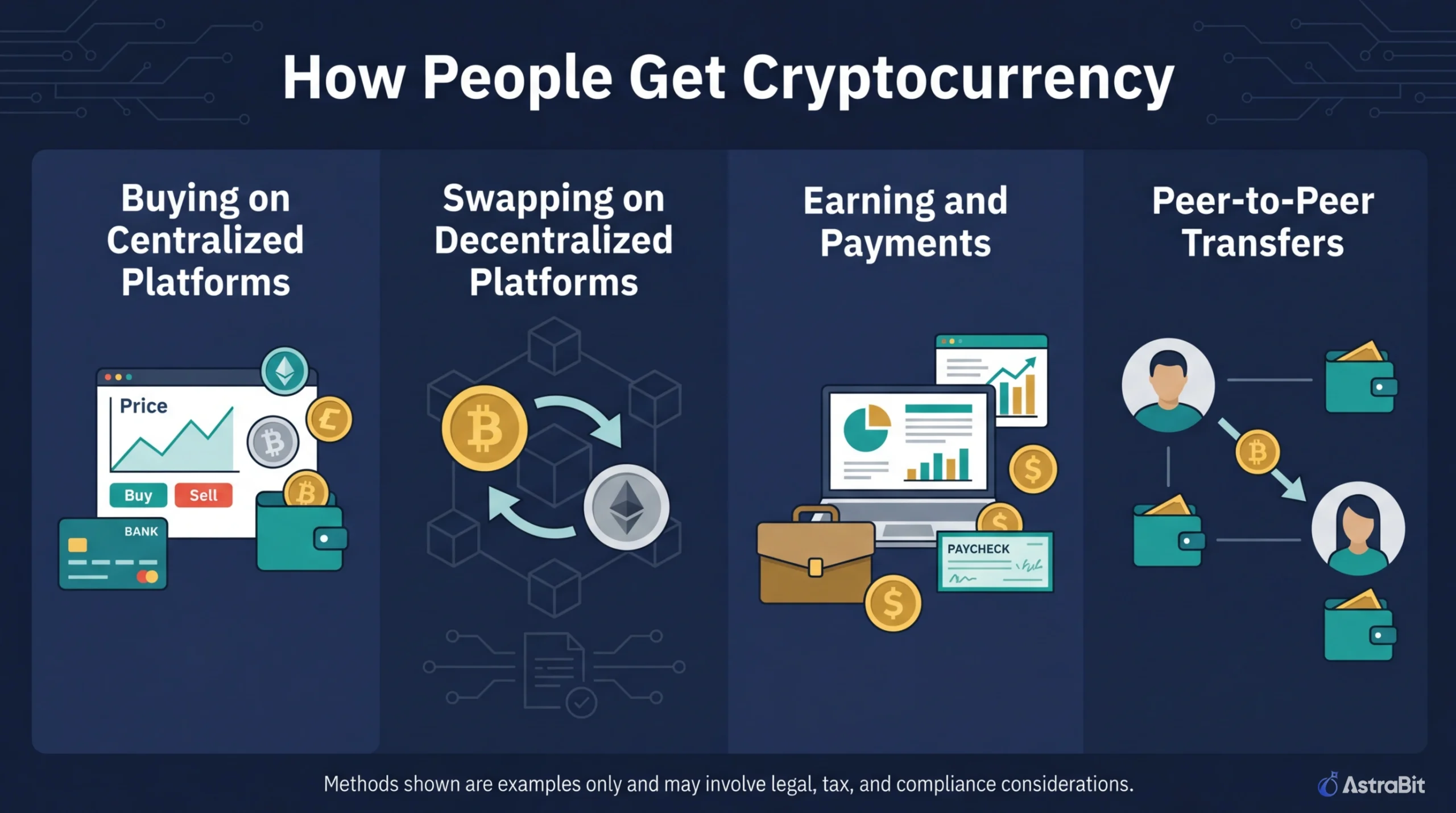

There are several common ways individuals obtain cryptocurrency:
Buying through centralized platforms
Many people use centralized platforms (often called exchanges or brokerages) that let them deposit traditional currency and purchase crypto. These platforms typically require identity verification and have their own account terms and risk controls.
Swapping on decentralized platforms
Users with cryptocurrencies already in a wallet can exchange one asset for another through decentralized exchanges (DEXs) that rely on smart contracts and liquidity pools.
Earning and payments
Some people are paid in cryptocurrency for goods, services, or work. Others may receive rewards, staking income, or other forms of on‑chain distributions, depending on the protocols they use.
Peer‑to‑peer transfers
Individuals can send cryptocurrency directly to one another using wallet addresses. This can include moving funds between your own wallets, or sending to friends, family, or business counterparties.
In every case, local regulations, tax rules, and compliance requirements apply. Holding, trading, or receiving cryptocurrency may create reporting obligations that users should understand.
Why Cryptocurrency Has Value (and Why Prices Move)
There is no single reason cryptocurrency has value; it depends on the specific asset and how people use it. Factors can include:
- Perceived usefulness in a network or application.
- Supply schedules and rules for how new units are created.
- Market sentiment, news, and macroeconomic conditions.
- Expectations about future adoption or regulation.
Cryptocurrency prices can move quickly and unpredictably. The fact that an asset has traded at a particular price in the past does not mean it will maintain or return to that level.
Potential Benefits and Limitations
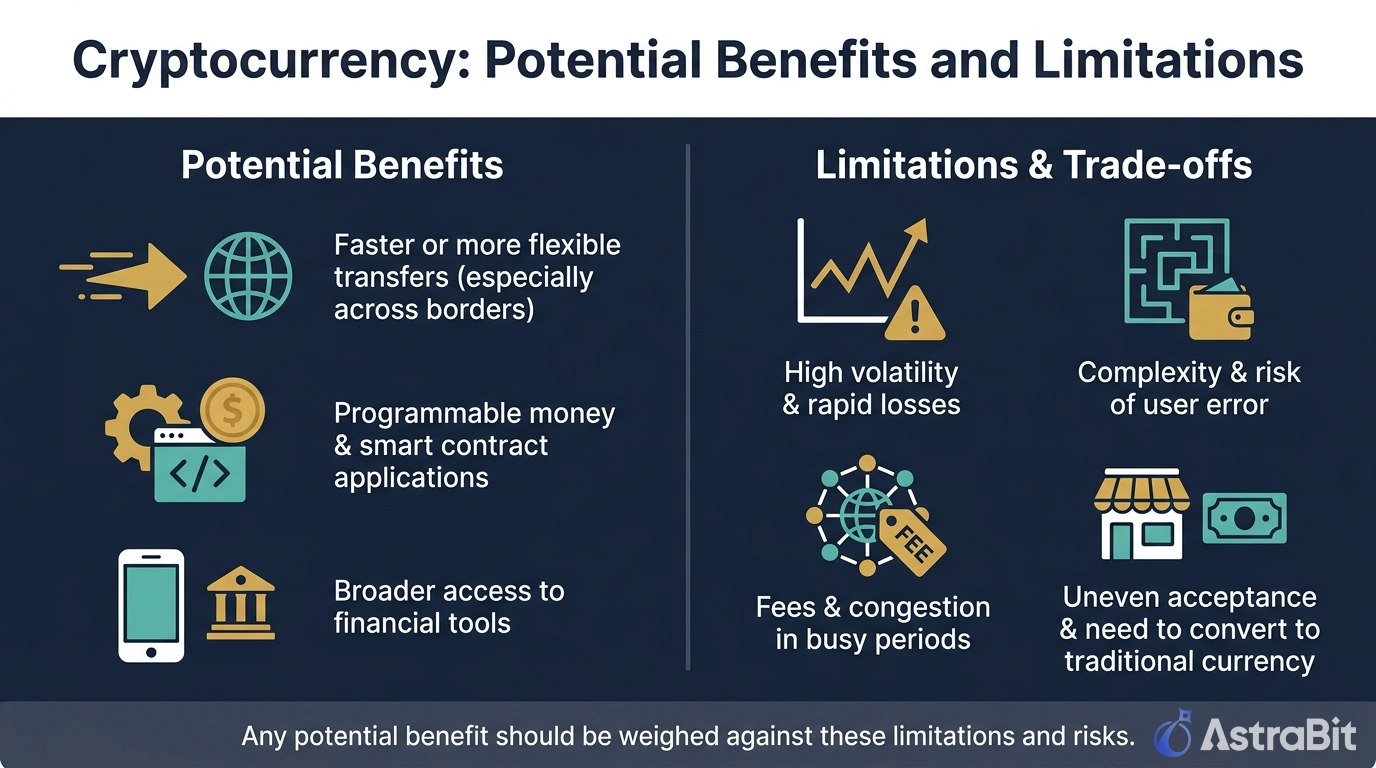

People see different potential benefits in cryptocurrency, but each comes with trade‑offs.
Possible benefits:
- Faster or more flexible transfers, especially across borders.
- Programmable money and applications built on smart contracts.
- Broader access to financial tools in some regions.
Limitations and trade‑offs:
- High volatility and the possibility of large, rapid losses.
- Complexity and the potential for user error.
- Fees and congestion during busy periods.
- Uneven acceptance and the need to convert back to traditional currency for many expenses.
Any potential benefit should be considered alongside these limitations and risks.
Key Risks to Understand
Cryptocurrency involves multiple layers of risk. This section highlights some of the main categories; it is not exhaustive.
- Market risk – Large, rapid price swings can lead to losses.
- Technology risk – Bugs, vulnerabilities, or design flaws can affect wallets, protocols, or networks.
- Operational and custody risk – Lost keys, insecure devices, or compromised software can result in loss of control over assets.
- Counterparty and platform risk – Exchanges, custodians, or protocols can experience outages, restrictions, or failures.
- Regulatory and policy risk – Changing laws and rules can affect how and where crypto can be used or traded.
- Fraud and scams – Phishing, impostor sites, fake investment schemes, and other scams target crypto users.
Understanding these risks is an important part of evaluating whether and how to engage with cryptocurrency.
Is Cryptocurrency Right for You?
Deciding whether to interact with cryptocurrency is a personal decision. Some questions that may help you think through it:
- What are your financial goals and time horizon?
- How would you react if the value of a position dropped significantly in a short period?
- How comfortable are you with managing passwords, devices, and security practices?
- Do you understand the specific assets and platforms you are considering using?
- How would involvement with cryptocurrency fit into your broader financial situation?
This guide is informational and does not recommend any particular asset, platform, or strategy. For personalized guidance, it can be helpful to speak with a licensed financial professional who understands your specific circumstances.
FAQs
Is cryptocurrency the same as digital money in my bank app?
Not exactly. Bank balances are claims on funds held by a bank or institution. Cryptocurrencies are digital assets recorded on separate networks, with transfers governed by network rules rather than a single intermediary.
Can cryptocurrency be converted back to traditional currency?
In many regions, users can convert between cryptocurrency and traditional currencies through platforms that support those services, subject to local laws, fees, and availability.
Is cryptocurrency anonymous?
Most major public blockchains are better described as pseudonymous. Addresses are visible, and transactions can often be analyzed or linked to real‑world identities through other data.
Can I lose all of my money in cryptocurrency?
Yes. Prices can fall sharply, and technology, operational, or counterparty issues can also lead to losses. You should only commit amounts you can afford to lose and consider the risks carefully.
Do I have to pay taxes on cryptocurrency?
In many jurisdictions, cryptocurrency transactions can have tax consequences, such as capital gains or income. Rules vary, so it is important to check local regulations and consult tax professionals where appropriate.
Key Terms Glossary
- Blockchain – A shared, append‑only ledger that records transactions in blocks linked together in sequence.
- Wallet – Software or hardware that helps you manage cryptographic keys and interact with cryptocurrency networks.
- Private key – A secret piece of information used to prove control over an address and authorize transactions.
- Public key / address – A string you can share with others so they can send you cryptocurrency.
- Stablecoin – A token designed to maintain a more stable value, often linked to a traditional currency or asset.
- Altcoin – Informal term for any cryptocurrency other than the first widely known one.
- Centralized exchange (CEX) – A platform run by a company or organization that matches buyers and sellers and typically holds user funds in custody.
- Decentralized exchange (DEX) – A protocol that lets users trade directly from their own wallets using smart contracts and liquidity pools.
- DeFi (Decentralized Finance) – A collection of on‑chain protocols that provide financial services like lending, borrowing, and swapping without a central operator.
Related Concepts
If you want to go deeper on specific topics, it can be helpful to explore:
- What Is Crypto Trading?
- What Is a Centralized Exchange (CEX)?
- What Is a Decentralized Exchange (DEX)?
- What Is DeFi?
These educational topics build on the basics covered here and can help you form a more complete picture of how cryptocurrency fits into the broader digital asset landscape.
Disclosure
This material is provided for educational and informational purposes only and is not intended to promote or recommend any specific product, service, platform, or strategy. The information contained herein is provided “as is,” without any representations or warranties of any kind, express or implied, including without limitation any warranty as to accuracy, completeness, timeliness, or materiality. Nothing in this material should be construed as financial, investment, legal, tax, or other professional advice, and you should not rely solely on it when making decisions. Some or all of the content, including any edits or revisions, may have been generated or assisted by artificial intelligence tools and may contain errors or omissions. The authors and publishers of this material disclaim any and all liability arising from the use of or reliance on this information.