
Web3 refers to a new wave of internet applications built on blockchains, where users control their own assets and identities through wallets instead of relying entirely on centralized platforms.
What Is Web3? How It Works, Examples, Benefits, and Risks (Beginner Guide)
What is Web3 (Quick Answer)
Web3 refers to blockchain-based applications where users control their assets and identities through wallets instead of centralized platforms, enabling digital ownership, programmable transactions, and shared infrastructure.
Web3 is often described as the next evolution of the internet, but definitions vary. At its core, it changes who owns digital assets and how applications interact.
In simple terms:
Web3 is a way of using the internet where users control their assets and accounts through blockchain-based systems instead of relying entirely on centralized platforms.
This guide explains what Web3 is, how it works, and what to consider before using it.
A centralized exchange (CEX) is a company‑operated crypto trading platform where you open an account, pass identity verification and compliance checks such as KYC/AML, deposit funds, and trade on the exchange’s internal order books.
It builds on earlier phases of the internet by adding digital ownership, programmable money, and shared infrastructure that many apps can plug into.
Core building blocks of Web3 include blockchains, smart contracts, tokens, and Web3 wallets.
Web3 is still early: user experience, security, and regulation are evolving, and real opportunities exist alongside meaningful risks.
What People Mean by “Web3”
When people talk about Web3, they are usually talking about a vision for the internet where ownership and control shift from centralized platforms back toward users and open networks. Instead of your accounts, balances, and data living only inside one company’s database, they are represented as on‑chain assets that you access through a wallet across many different apps.
A helpful way to think about it is through the evolution of the web:
- Web1 (“read”) – Static websites you mostly read, like early homepages and basic blogs.
- Web2 (“read‑write”) – Interactive, social platforms where you create content but platforms control data and monetization.
- Web3 (“read‑write‑own”) – Apps that still let you interact and create, but where you can also own digital assets and identities directly through a wallet tied to a blockchain.
In other words, Web3 is less about any single app or token and more about how the internet is built and who ultimately owns what.
Core Building Blocks of Web3
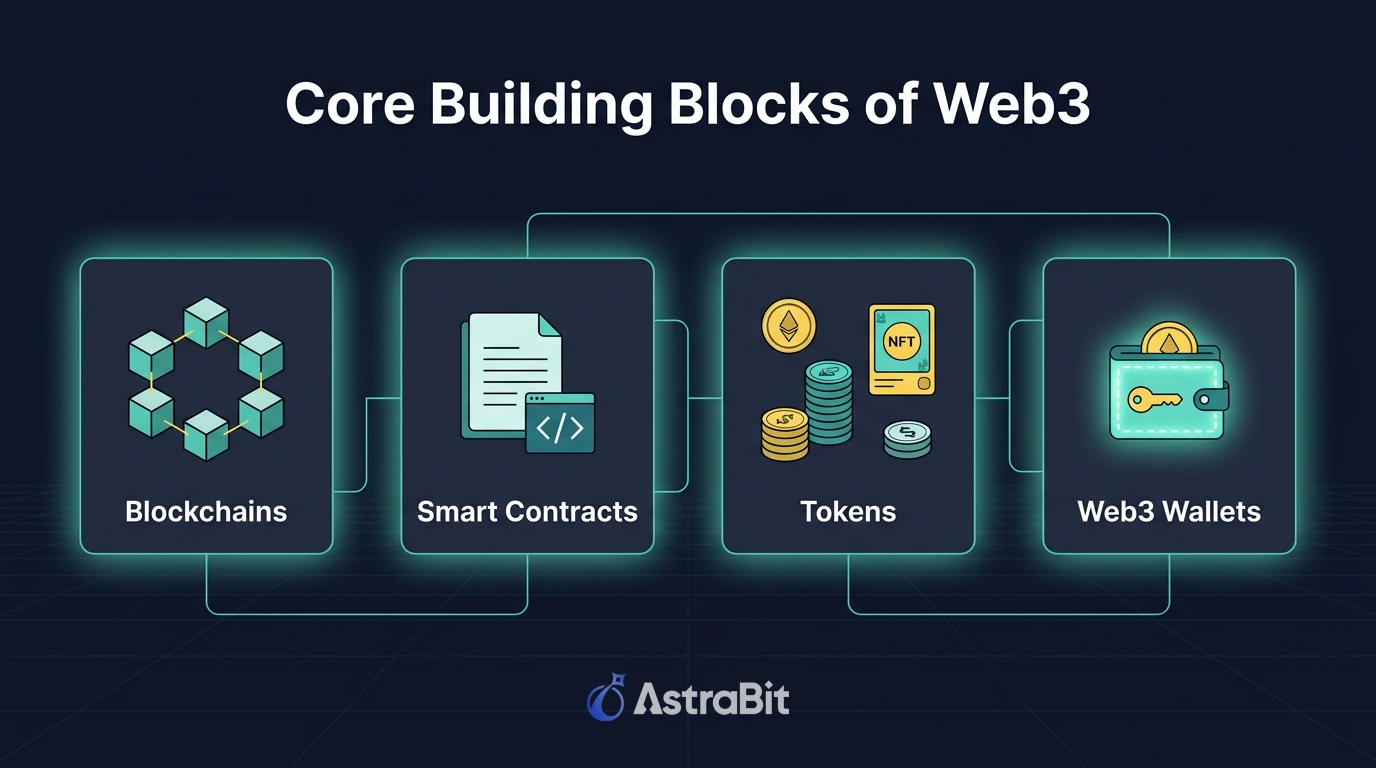
Under the Web3 buzzword, there are a few concrete technologies that do most of the work.
Blockchains as shared infrastructure
Blockchains are distributed ledgers that many independent participants maintain together. They record transactions and state changes in ordered blocks that are difficult to alter after the fact, providing a shared source of truth for balances and program logic.
Smart contracts as on‑chain logic
Smart contracts are programs deployed on blockchains that run according to predefined rules. When users send transactions to these contracts—through wallets or apps—the contracts update state, enforce conditions, and can move assets without relying on a central operator to push buttons manually.
Tokens as digital assets
Tokens are blockchain‑based representations of value or rights that can move between addresses:
- Fungible tokens act like currencies or shares, where each unit is interchangeable.
- Non‑fungible tokens (NFTs) represent unique items, such as specific collectibles, tickets, or membership passes.
Web3 apps use tokens for payments, access control, incentives, and representing ownership or claims.
Web3 wallets as user accounts
A Web3 wallet is software that helps you generate and manage cryptographic keys, hold tokens, and interact with apps. Instead of creating separate usernames and passwords for every service, you connect the same wallet to different Web3 apps and approve transactions as needed.
How Web3 Works Step by Step
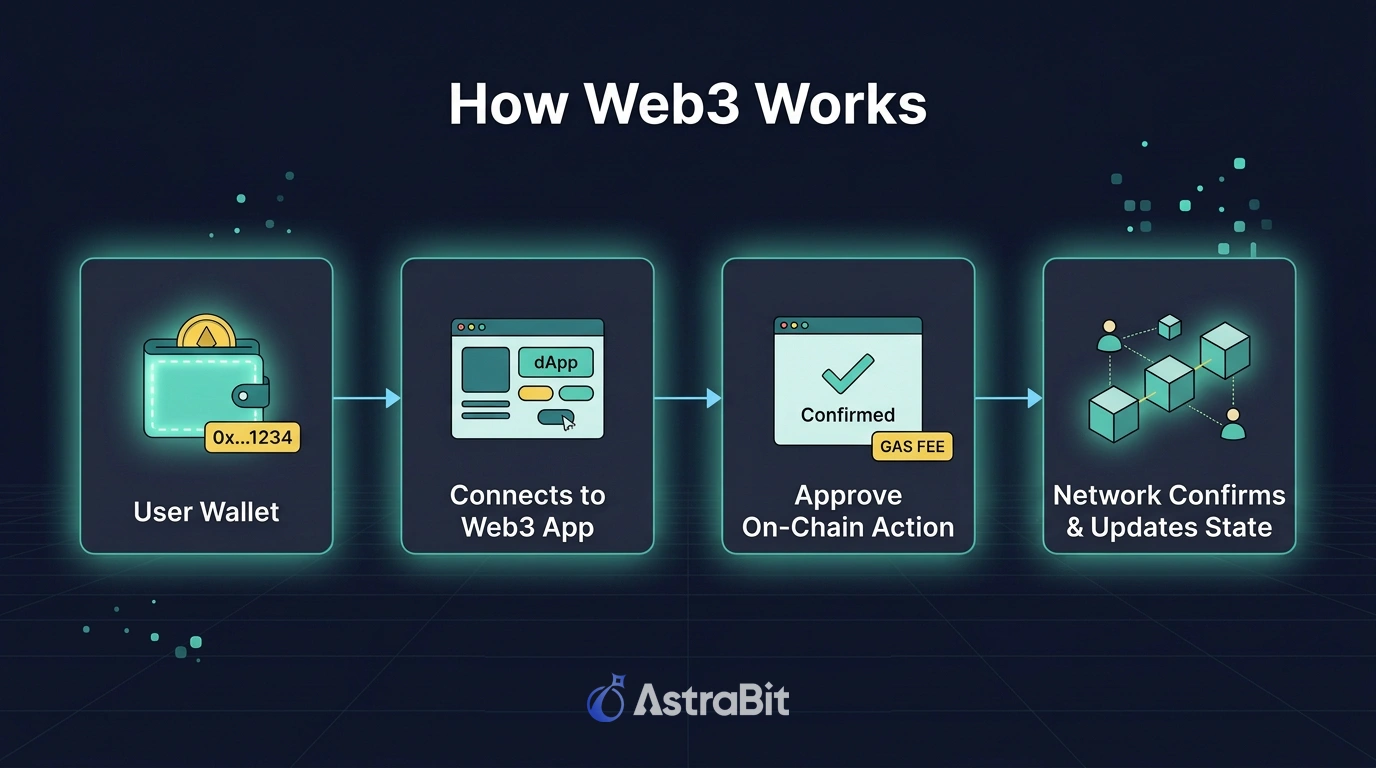
The user journey in Web3 looks different from logging in to a traditional website, but the sequence is consistent.
You control a wallet
You start by creating a Web3 wallet—browser extension, mobile app, or a custody solution—which generates cryptographic keys and gives you a recovery method. The wallet address becomes your primary account in the Web3 world.
You connect to a Web3 app
When you visit a Web3‑enabled site or dapp, it prompts you to connect your wallet. Connecting lets the app see your public address and available assets, but not your private keys, and sets up a secure channel to request transactions.
You approve on‑chain actions
Whenever the app needs to do something on‑chain—send tokens, interact with a smart contract, open a position—it asks your wallet to approve a transaction. You review what is being requested, see fees, and decide whether to sign or reject.
The network confirms and records changes
Signed transactions are broadcast to the blockchain network, where validators or miners check them and include them in blocks according to consensus rules. Once confirmed, your wallet and all other apps reading that chain see the updated balances or contract state.
Because this logic runs on shared infrastructure, the same wallet and assets can work across many different apps, which is a core part of the Web3 value proposition.
What People Use Web3 For Today
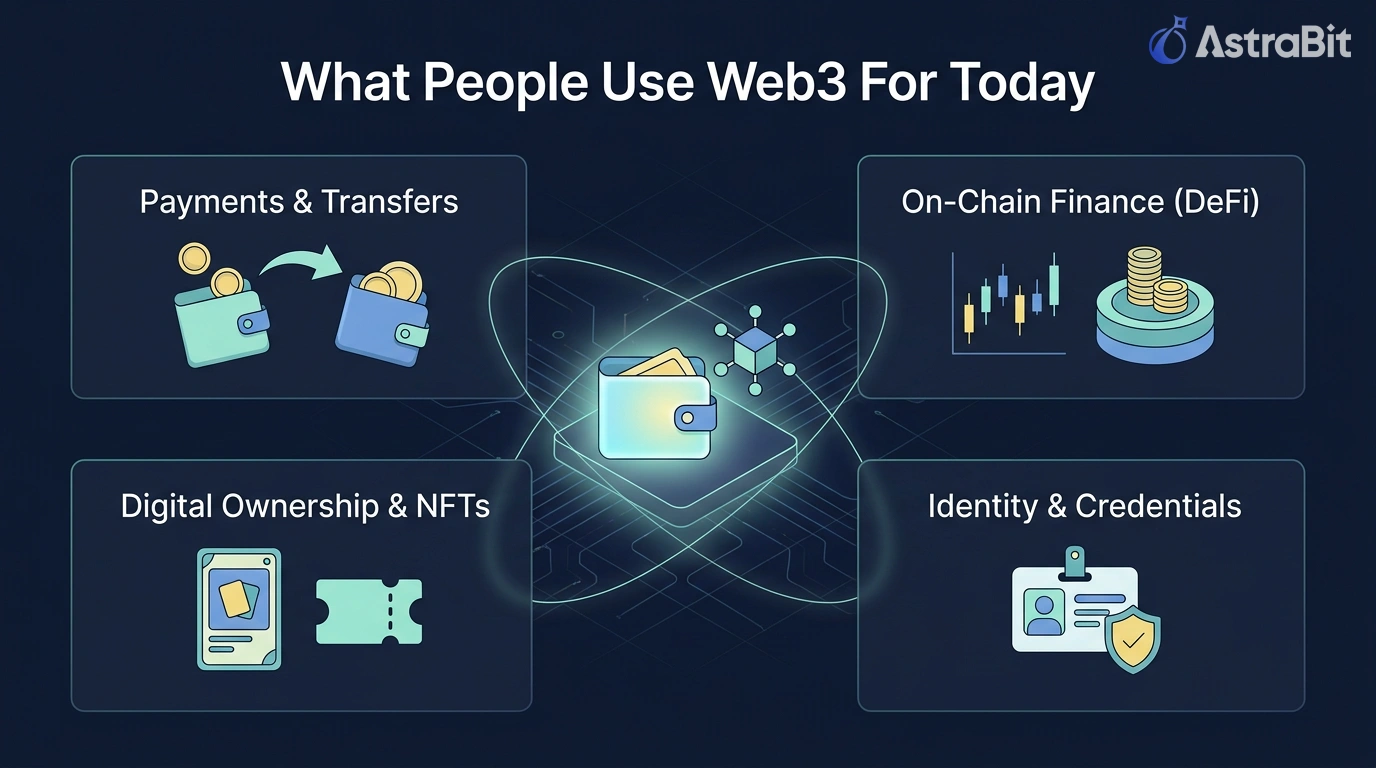
Web3 is broad, but a few categories cover most current activity.
Transferring and holding digital assets
People use Web3 to hold and transfer cryptocurrencies and stablecoins, often for payments, remittances, or as part of a diversified portfolio. Wallets give them direct control, though many still rely on exchanges and custodians as bridges.
Trading and on‑chain finance
Decentralized exchanges, lending protocols, and derivatives platforms run largely through smart contracts. Traders and investors can swap assets, borrow and lend, or use automated strategies by interacting with these contracts from their wallets, sometimes alongside centralized venues.
Digital ownership and access
NFTs and token‑gated experiences use Web3 rails to power collectibles, in‑game items, membership passes, and ticketing. Ownership can be verified on‑chain, and apps can grant features or access based on which tokens a wallet holds.
Identity, credentials, and experimentation
Projects are exploring on‑chain identity, reputation, and verifiable credentials that wallets can present across apps. These experiments are early but aim to reduce the need to repeatedly submit the same information while giving users more control over what they share.
Potential Benefits of Web3
Web3 introduces some capabilities that are hard to replicate in traditional, purely centralized systems.
User ownership and portability
Because wallets hold keys to assets and identities, users can move between apps without starting from scratch each time. If one app shuts down or changes direction, you may still control the underlying assets and can bring them elsewhere.
Open and composable infrastructure
Smart contracts and token standards are typically open for others to build on. This composability lets developers combine existing protocols like building blocks, creating new products that plug into established liquidity, data, or identity systems.
Global, always‑on access
As long as users have a compatible wallet, network access, and comply with applicable law, they can interact with Web3 apps without needing to open local bank or brokerage accounts in every jurisdiction. This can broaden access—but also requires careful consideration of regulations and risk.
Programmable money and logic
Because assets and logic live on the same infrastructure, Web3 can support use cases like automated payouts, escrow, conditional transfers, and complex financial workflows with fewer manual steps. This programmability is central to many DeFi and automation use cases.
Limitations and Trade‑Offs
Alongside potential benefits, Web3 introduces real challenges.
Complexity and user‑error risk
Managing wallets, recovery phrases, and contract approvals is more complex than using a typical Web2 app. Losing a recovery phrase, signing malicious transactions, or interacting with a fake contract can result in permanent loss.
Volatility and speculation
Many Web3 assets are highly volatile, and a large share of activity is still driven by speculation and trading rather than long‑term use. Price swings can be extreme, and not every token or project is designed to last.
Security and smart‑contract risk
Bugs, exploits, and phishing campaigns have affected even widely used Web3 projects. Audits and security tools can help but cannot eliminate risk; users and builders need to assume that contract‑level issues are possible.
Regulatory and legal uncertainty
Rules governing digital assets, decentralized protocols, and data use vary by jurisdiction and are still evolving. Web3 participation does not remove legal or tax obligations; businesses and individuals may need specialized advice to navigate requirements.
How Web3 Interacts With Today’s Platforms
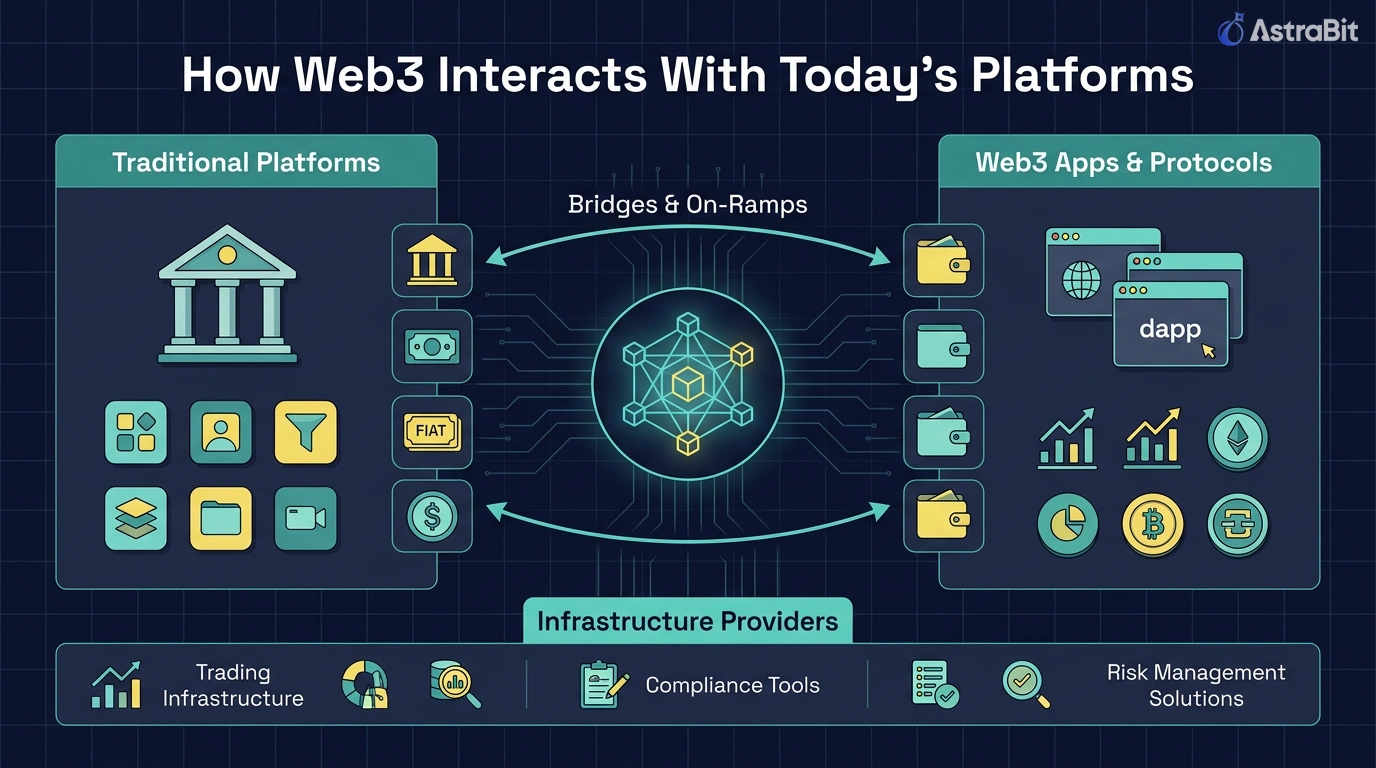
Most people experience Web3 through a mix of traditional and blockchain‑based services.
Bridges between traditional platforms and Web3
Centralized exchanges, custodians, and on‑ramp providers let users move between bank accounts and Web3 wallets. They handle identity verification, fiat payments, and some risk functions while giving access to on‑chain assets and apps.
Hybrid models
Many products use familiar Web2 interfaces while relying on Web3 under the hood. Examples include custodial wallets embedded in apps, services that manage keys on behalf of users, and platforms that route orders across both centralized and decentralized venues.
The role of infrastructure providers
Trading infrastructure, connectivity, compliance tooling, and risk‑management platforms sit beneath many Web3‑facing products. They help applications connect to multiple chains and venues, implement controls, and support more complex workflows such as automated trading or institutional access.
Is Web3 Right for You?
Web3 is not all‑or‑nothing. It may make sense for some use cases and not others.
Questions for everyday users
- Am I comfortable managing a wallet or choosing a service to manage keys on my behalf?
- How would I react if the value of my Web3 assets moved up or down quickly?
- Do I understand that transactions can be irreversible and that mistakes may be hard to fix?
Questions for businesses and builders
- Does blockchain‑based ownership or programmability solve a real problem for my customers?
- Which parts of my workflow actually benefit from decentralization, and which are better handled through traditional systems?
- What regulatory, operational, and security requirements would apply if I integrate Web3 components?
This article is informational and does not recommend using or avoiding any specific Web3 product. For decisions that affect your finances or business, it can be helpful to consult qualified professionals who understand your circumstances and local rules.
FAQs About Web3
Is Web3 the same as crypto?
Not exactly. Crypto assets are a key part of Web3, but Web3 also refers to the broader architecture and idea of user‑owned accounts, programmable apps, and shared infrastructure.
Do I need a wallet to use Web3 apps?
For fully on‑chain apps, you generally need a wallet to hold assets and sign transactions, though some services embed wallets or custody solutions so users don’t directly manage keys.
Is Web3 safer or riskier than traditional finance?
Web3 reduces some risks tied to single centralized operators but introduces new ones around key management, smart‑contract vulnerabilities, and evolving regulation. Whether it is “safer” depends on how it is used.
Is Web3 only about finance and trading?
No. Many early use cases are financial, but Web3 is also being explored for gaming, identity, ticketing, supply‑chain tracking, and more.
Can Web3 be used without users handling private keys directly?
Yes. Custodial wallets, smart‑contract wallets, and account‑abstraction approaches can mask some key‑management complexity, though they come with their own trade‑offs in terms of trust and control.
Key Terms Glossary
- Web3 – A broad term for internet applications built on blockchain‑based infrastructure that emphasize user ownership, programmable assets, and decentralized control.
- Blockchain – A distributed ledger that records transactions and state changes in ordered blocks maintained by many independent participants.
- Smart contract – Code deployed on a blockchain that runs according to predefined rules when triggered by transactions.
- Decentralized application (dapp) – An application that uses smart contracts and blockchain infrastructure rather than relying only on centralized servers.
- Token – A blockchain‑based representation of value or rights, which can be fungible (interchangeable units) or non‑fungible (unique items).
- Web3 wallet – Software or a service that manages keys, holds tokens, and lets you interact with Web3 apps by signing transactions.
- Gas fee – The fee paid to validators or miners to process transactions and run contract logic on a blockchain.
Related Concepts
- What is a Web3 Wallet (how users interact with apps)
- What is a Web3 Super App (how multiple services connect)
- What is a Trading Bot (automation within Web3 markets)
- What is Tokenization (how assets are represented on-chain)
Disclosure
This material is provided for educational and informational purposes only and is not intended to promote or recommend any specific product, service, platform, or strategy. The information contained herein is provided “as is,” without any representations or warranties of any kind, express or implied, including without limitation any warranty as to accuracy, completeness, timeliness, or materiality. Nothing in this material should be construed as financial, investment, legal, tax, or other professional advice, and you should not rely solely on it when making decisions. Some or all of the content, including any edits or revisions, may have been generated or assisted by artificial intelligence tools and may contain errors or omissions. The authors and publishers of this material disclaim any and all liability arising from the use of or reliance on this information.