
Gas fees are charges you pay to get a transaction processed on a blockchain. They compensate the network’s validators or miners for verifying your transaction and adding it to the chain, and they change based on how busy the network is and how complex your transaction is.
What Are Blockchain Gas Fees? A Beginner’s Guide
If you have ever sent crypto, interacted with a DeFi application, or traded on-chain, you have likely encountered gas fees. Blockchain gas fees are the costs required to process and validate transactions on a blockchain network.
These fees play a key role in keeping networks operational, compensating validators, and prioritizing transactions during periods of high demand. However, gas fees can vary significantly depending on network activity, transaction complexity, and timing.
This guide explains what gas fees are, why they exist, how they work, and what factors influence their cost so you can better understand how to navigate them.
Gas fees are payments required to have a transaction processed and recorded on a blockchain, and they exist to compensate the validators or miners who keep the network running.
The amount you pay can change based on network demand, transaction complexity, and the fee rules of the blockchain you are using.
Some networks and layer-2 systems are built to keep fees lower or more predictable, while heavily used smart-contract networks can become much more expensive during busy periods.
High gas fees can make small or frequent transactions less practical, which is why timing, network choice, and wallet fee settings can have a real impact on cost.
Why Gas Fees Exist
Blockchains are run by independent participants who operate hardware, store data, and validate transactions. Gas fees give them an economic reason to provide that service instead of using their resources elsewhere.
Gas fees also help:
Prevent spam and abuse
Requiring a fee for every transaction makes it expensive to flood the network with useless activity.
Prioritize transactions
When blocks have limited space, higher fees signal higher urgency and tend to be included sooner.
Allocate scarce capacity
Fees create a market for block space so that, in busy times, only transactions that users value enough to pay for are processed.
Without some form of transaction fee, most public blockchains would be easy to congest or attack and hard to operate sustainably.
How Gas Fees Work (Simple Overview)
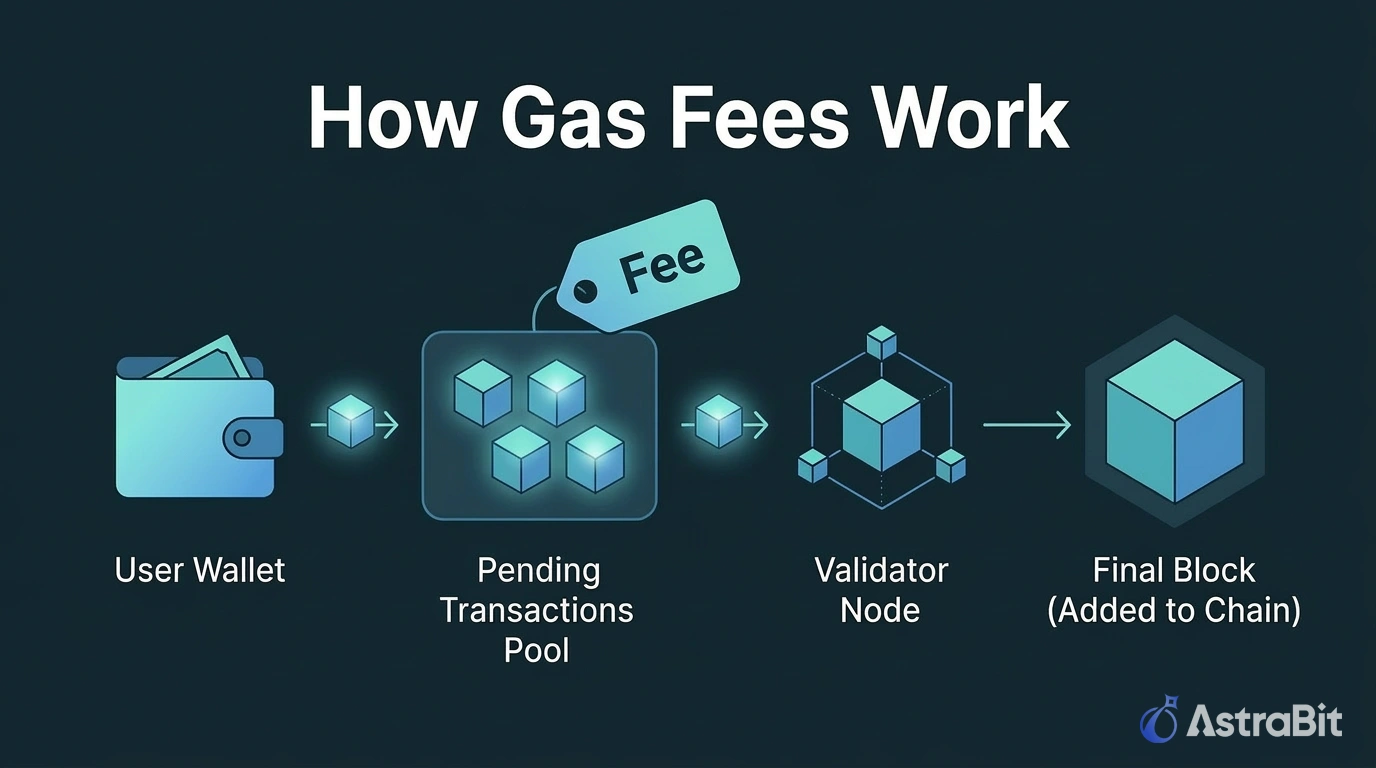
Every time you send a transaction, you are effectively making an offer: “I will pay this much for validators to include this in a block.” This is what your wallet’s gas price, max fee, or priority fee settings are estimating for you before you hit confirm.
You initiate a transaction
You use a wallet or app to send crypto, interact with a smart contract, or place an on‑chain trade. The app shows an estimated gas fee.
The transaction is sent to the network
Your signed transaction goes to a pool of pending transactions where validators or block producers can see it.
Validators select transactions for the next block
Validators choose which pending transactions to include when they build a new block. On many networks, they earn more by including transactions that pay higher fees.
Higher‑fee transactions often confirm faster
If the network is busy, validators are more likely to pick higher‑paying transactions first. Lower‑fee transactions may wait longer or be dropped if they are under-priced.
The transaction is confirmed and recorded
Once your transaction is included in a block and that block is accepted by the network, the gas fee is paid out according to the chain’s rules, and your balances and contract state are updated on‑chain. The exact math depends on the blockchain’s fee model.
What Affects Gas Fees?
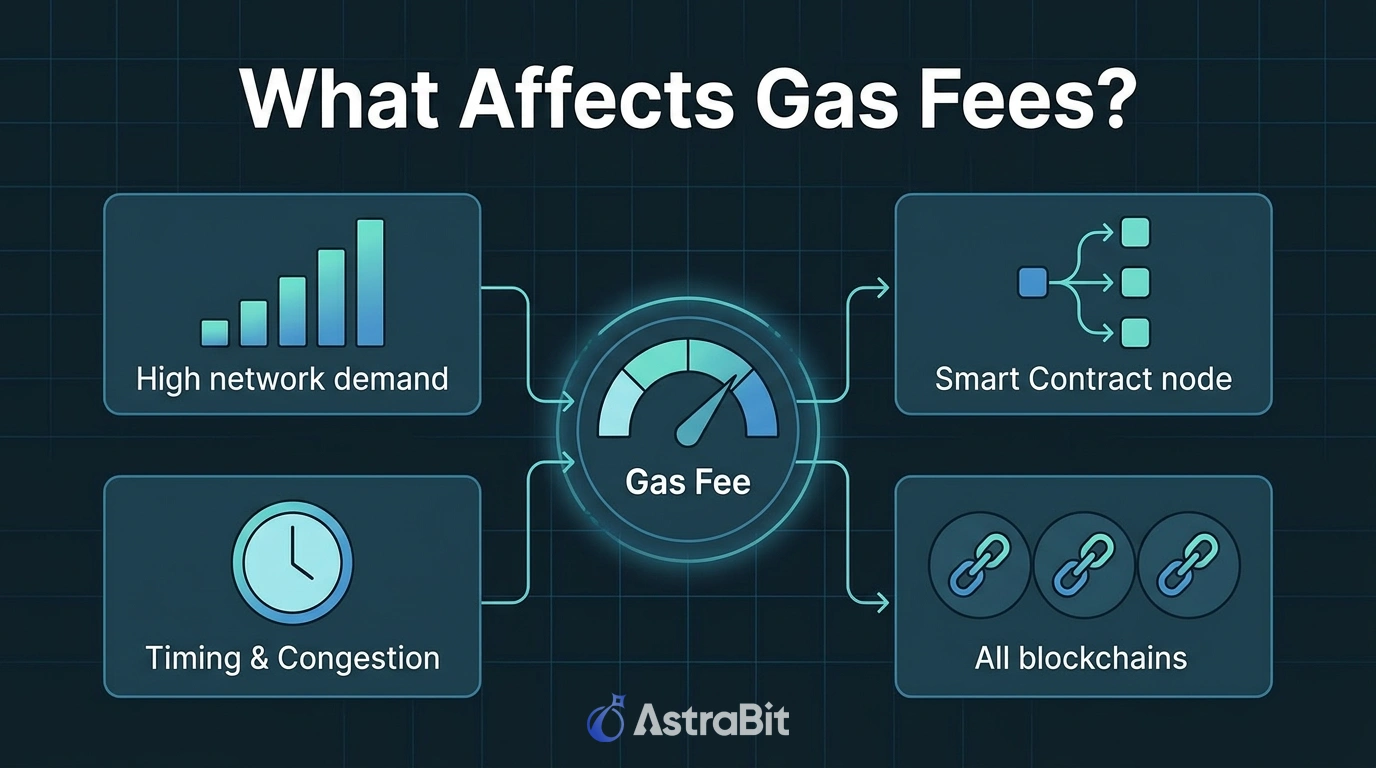
Gas fees are not fixed. They change from moment to moment based on how you are using the network and what everyone else is trying to do.
Network demand
- When many users are sending transactions at the same time, competition for block space increases.
- Validators can only include a limited number of transactions per block, so users raise fees to get included sooner.
- During major market moves or popular NFT or DeFi events, fees can rise sharply.
Transaction complexity
- A simple transfer, such as sending one token from one address to another, usually uses less gas than interacting with a complex smart contract.
- Smart-contract calls that trigger multiple checks, loops, or external calls require more computation and storage changes, which increases the gas used.
- Even with the same gas price, a transaction that uses more gas units will cost more overall.
Blockchain design and fee model
- Different blockchains have different block sizes, confirmation times, and fee mechanisms.
- Some chains prioritize low fees and high throughput, while others prioritize decentralization and security even at the cost of higher fees.
- Upgrades and protocol changes can alter how base fees are calculated or how fees are shared, burned, or rewarded.
- In practice, this is why a transaction can feel expensive on a busy smart-contract chain but much cheaper on some lower-fee networks or layer-2 systems.
Timing
- For non-urgent transactions, timing them during quieter periods can reduce costs.
- Activity on many networks follows patterns across the day and week.
- Fees can be lower during off-peak hours and higher when global markets or popular apps are most active.
Gas Fees Across Different Blockchains
While the idea of paying for block space is common, implementation differs from chain to chain.
- High‑throughput, low‑fee networks aim to support many transactions per second with modest fees, useful for small payments or frequent app interactions.
- Smart‑contract platforms with heavy activity can see more volatile fees, especially when popular applications drive sudden demand.
- Layer‑2 solutions built on top of base chains bundle many transactions together and submit them in batches, spreading the cost and often offering lower fees to end users.
- Alternative architectures may use fixed fees, bandwidth‑style models, or other approaches to smooth out costs.
Understanding how your chosen network handles fees can make it easier to estimate costs and choose the right tools.
FAQs
Why are gas fees sometimes so high?
Gas fees often rise when many people are trying to use the same blockchain at once. Because blocks have limited space, users effectively bid for inclusion by offering higher fees, which pushes average costs up during busy periods.
Do all cryptocurrencies have gas fees?
Most public blockchains use some form of transaction fee to compensate validators and protect the network from spam, but the level and structure of those fees vary. Some networks are designed for very low‑cost transactions, while others can become expensive under load.
Can I avoid paying gas fees altogether?
You generally cannot submit a transaction on a public blockchain without some fee. However, you can reduce costs by using lower‑fee networks, layer‑2 solutions, or timing non‑urgent transactions for periods when demand is lower.
What happens if I set the gas fee too low?
If your fee is too low relative to current conditions, your transaction may take a long time to confirm or be dropped from the queue. In that case, you may need to resubmit with a higher fee or use features in your wallet or app to replace or cancel the pending transaction where supported.
Do I get gas fees back if a transaction fails?
Not usually. Even if a transaction fails or a smart‑contract call reverts, validators still spent resources to process it. As a result, you typically lose some or all of the gas you offered for that transaction.
Related Concepts
- What Is a Blockchain?
- What Is a Decentralized Exchange (DEX)?
- What Is DeFi (Decentralized Finance)?
- What Is a Crypto Wallet?
Disclosure
This material is provided for educational and informational purposes only and is not intended to promote or recommend any specific product, service, platform, or strategy. The information contained herein is provided “as is,” without any representations or warranties of any kind, express or implied, including without limitation any warranty as to accuracy, completeness, timeliness, or materiality. Nothing in this material should be construed as financial, investment, legal, tax, or other professional advice, and you should not rely solely on it when making decisions. Some or all of the content, including any edits or revisions, may have been generated or assisted by artificial intelligence tools and may contain errors or omissions. The authors and publishers of this material disclaim any and all liability arising from the use of or reliance on this information.