
A centralized exchange (CEX) is a crypto trading platform operated by a centralized entity or company. They are one of the most common ways people buy and trade cryptocurrency.
What Is a Centralized Exchange (CEX)? How Platform‑Based Crypto Trading Works
A centralized exchange (CEX) is a company‑run crypto trading platform where you open an account, complete identity checks when applicable, deposit funds, and trade on an internal order book the exchange controls. It feels similar to using a stock brokerage, but the products are digital assets instead of shares.
Centralized exchanges are often the first place people encounter crypto trading because they provide a familiar account‑based experience: you sign up, verify your identity, deposit money, and trade through a web or mobile interface.
Unlike decentralized exchanges that run on smart contracts, CEXs operate on their own servers and internal ledgers. The company controls custody of deposited funds, runs the order books, and decides which assets and features to support.
This guide explains what a centralized exchange is, how spot trading on a CEX works, and the potential benefits, limitations, and risks. It is for education only and does not recommend any specific platform or strategy.
A centralized exchange (CEX) is a company‑operated crypto trading platform where you open an account, pass identity verification and compliance checks such as KYC/AML, deposit funds, and trade on the exchange’s internal order books.
CEXs typically offer spot trading in popular pairs like BTC/USD or ETH/USDT, along with features such as fiat deposits and withdrawals, mobile apps, and customer support; some also offer margin and derivatives markets for advanced users.
Using a CEX means accepting custodial risk and platform risk—your assets are held and managed by the exchange, which can be affected by hacks, mismanagement, outages, or regulatory actions.
CEXs can be convenient on‑ramps with deep liquidity and a familiar UX, but you should understand how accounts, custody, and withdrawals work before deciding how much to keep on any single platform.
How Trading on a CEX Works
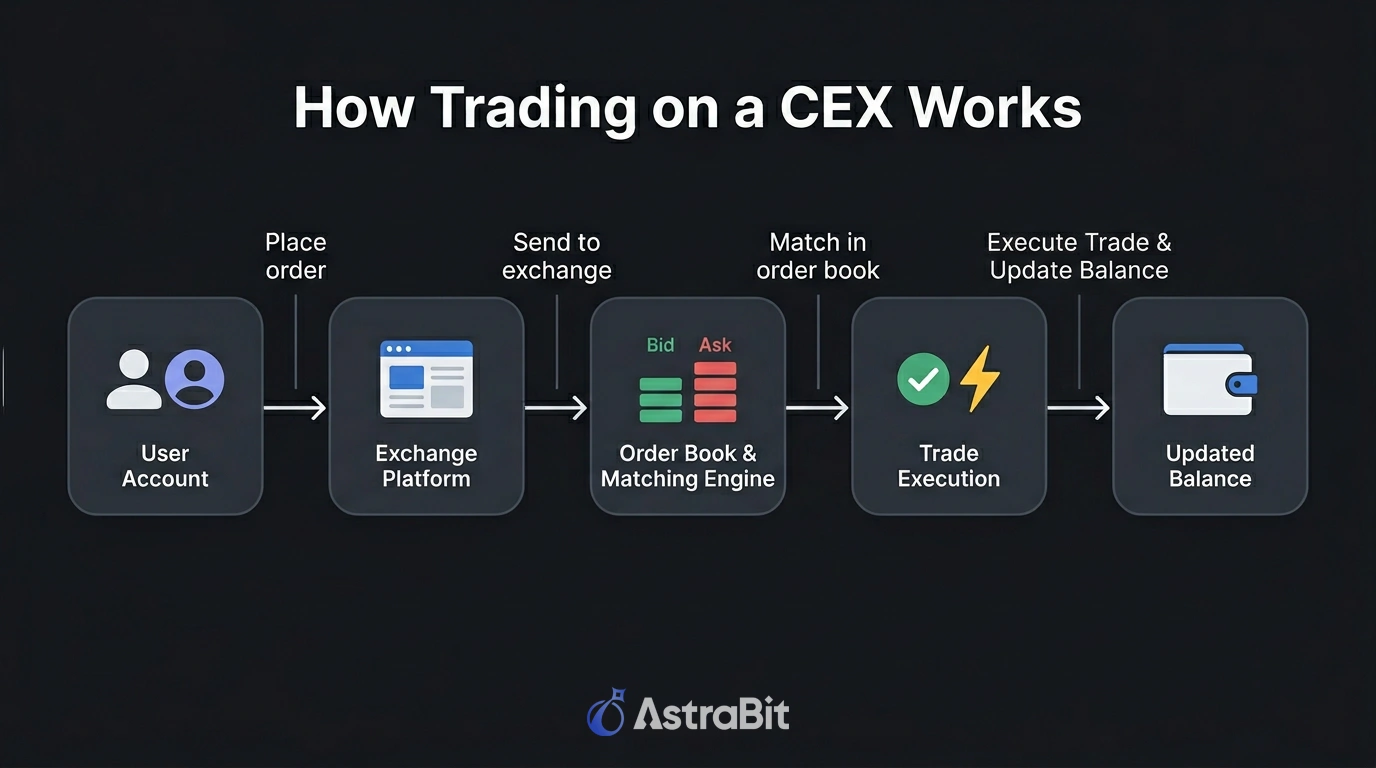
Trading on a centralized exchange feels like trading on a traditional brokerage platform. You open an account, deposit funds, choose a market such as BTC/USD, place buy and sell orders, and manage balances and open orders from a dashboard.
1. Create an account and verify your identity
You register with the exchange using an email address or phone number and set a password. To unlock full functionality—especially higher limits and fiat deposits—you are usually required to complete identity verification and compliance checks such as KYC/AML, which may include uploading identification documents, providing personal details, and sometimes proving the source of funds.
2. Secure your account
After signup, you are encouraged (and sometimes required) to add security features such as two‑factor authentication (2FA), SMS or app‑based approval codes, and anti‑phishing phrases. These tools help protect access to your account, but they do not change the fact that the exchange is the custodian of deposited assets.
3. Deposit funds
Once verified, you can fund your account in one or both of the following ways:
- Fiat deposits – Bank transfers, card payments, or other supported methods to move traditional currency (for example, USD or EUR) into your exchange balance.
- Crypto deposits – Sending digital assets from an external wallet to a deposit address provided by the exchange.
After confirmation, your balances appear in your account dashboard, and you can use them to trade.
4. Choose a trading pair
Inside the exchange, you select a market such as BTC/USD, ETH/USDT, or another listed pair. The trading screen typically shows:
- Your available balance in the relevant currencies
- A price chart
- An order book (open buy and sell orders)
- Recent trades
5. Select order type and size
For spot trading, you decide whether to buy or sell, then choose an order type:
- Market order – Fills immediately at the best available prices in the order book.
- Limit order – Specifies the price at which you are willing to buy or sell; the order sits in the book until the market reaches your price or you cancel it.
- Some exchanges also offer stop orders or other variations for more precise execution.
You enter either how much of the quote asset you want to spend (for example, 1,000 USD) or how much of the base asset you want to buy or sell (for example, 0.1 BTC). The exchange shows estimated totals and fees before you confirm.
6. Order matching and execution
When you submit your order:
- The exchange’s internal matching engine compares it with other orders in the book.
- If there is a match (for example, your buy price meets an existing sell price), the trade executes and becomes part of the exchange’s trade history.
- For limit orders that are not immediately filled, the order remains open until it is matched, canceled, or expires under the exchange’s rules.
All of this happens on the exchange’s own systems rather than directly on a public blockchain.
7. Balances and history update
After execution, your account balances update to reflect what you bought or sold, along with any trading fees charged. You can see:
- Updated asset balances
- A history of completed trades
- Any open orders that remain in the book
For users who enable margin or derivatives products where available, there may also be separate views for open positions, margin levels, and liquidation prices. These are typically offered as optional, more complex products.
8. Withdraw funds
When you want to move assets off the exchange:
- For crypto, you request a withdrawal to an external wallet address, and the exchange processes it, batching it into on‑chain transactions under its control.
- For fiat, you request a withdrawal to a linked bank account or other supported payout method.
Withdrawals are subject to the exchange’s policies, limits, processing times, and compliance checks.
How a CEX Actually Runs (Under the Hood)
From the user’s perspective, a CEX looks like a single application. Behind the scenes, it is a combination of custody systems, databases, trading infrastructure, and operational controls.
Custody and internal ledgers
When you deposit assets:
- Crypto assets are held in a mix of hot wallets (connected to the internet for operational use) and cold wallets (stored offline for security).
- Fiat balances may be held in bank accounts or equivalent arrangements in the exchange’s name.
- Your account balance is recorded on the exchange’s internal ledger, not directly on a public blockchain.
The exchange’s systems track how much each customer is owed and must ensure its on‑chain and bank holdings are sufficient to cover those obligations.
Order books and matching engines
Centralized exchanges run their own order books and matching engines to pair buy and sell orders efficiently:
- Order books are maintained in real time on the exchange’s servers, with updates streamed to the trading interface and APIs.
- The matching engine applies rules such as price–time priority, matching the best available orders first.
- Executions happen internally; the exchange updates its internal ledger to reflect who owns which assets after each trade.
Because this process is centralized, CEXs can process large volumes of orders quickly without waiting for blockchain confirmations.
Risk management and margin systems
For exchanges that offer margin or derivatives products:
- A risk engine tracks each user’s collateral, open positions, and exposure.
- The system applies initial and maintenance margin requirements and may charge funding or interest for leveraged positions.
- If a position falls below the required margin, the risk engine can trigger liquidation, closing the position to protect the platform and other users.
These features add flexibility but also increase complexity and risk, which is why they are generally aimed at more experienced traders.
Operations, security, and downtime
CEXs also manage:
- Security controls, such as hardware security modules (HSMs), internal access controls, and monitoring for suspicious activity
- Operational processes, including customer support, system maintenance, and incident response
- Downtime and maintenance windows, when trading or withdrawals may be limited or paused to deploy updates or address issues
All of these are handled centrally by the exchange operator, not by a decentralized network.
CEX vs. DEX: How They Differ
Centralized and decentralized exchanges both let you trade crypto assets, but they make different trade‑offs.
Neither model is universally better. Many people use both CEXs for fiat on‑ramps and major pairs, and DEXs for on‑chain activity and self‑custody.
| Aspect | Centralized Exchange (CEX) | Decentralized Exchange (DEX) |
| Custody | Exchange controls custodial wallets and internal ledger | Users trade from self‑custodied wallets via smart contracts |
| Identity & Process | Requires account creation and identity verification (KYC/AML) | Often wallet‑based access; some front‑ends restrict regions or users |
| Execution | Internal matching engine, fast updates on private systems | On‑chain or hybrid execution, speed depends on network |
| Transparency | Order books and prices visible; internal reserves and risk models less transparent | Settlement and contract behavior are on‑chain and verifiable |
| Fees | Trading and deposit/withdrawal fees set by the exchange | Protocol and network fees, possibly aggregator fees |
| Support & recourse | Customer support and some account‑recovery options | Limited to available tools and interfaces; usually no direct recourse |
| Regulatory interaction | Directly subject to regulators where it operates; may share data and enforce restrictions | Rules apply to users and interfaces, but core contracts may be globally accessible |
What People Use CEXs For
People use centralized exchanges for several practical reasons:
Fiat on‑ramps and off‑ramps
Direct ways to buy crypto with bank transfers, cards, or other payment methods, and to convert back to fiat.
Spot trading in major pairs
Trading well‑known assets like BTC and ETH against fiat or stablecoins, often with deeper liquidity and tighter spreads.
Convenience and familiar UX
Web and mobile apps, integrated charts, portfolio views, and notifications that feel closer to online banking or stock trading than managing wallets directly.
Additional services
Some exchanges offer staking, savings, lending, or card products. These services are separate from basic spot trading and come with their own terms and risks.
APIs for tools and automation
Advanced users and developers can connect bots or analytics tools to a CEX through its APIs for data and order execution.
Potential Benefits and Limitations of CEXs
Potential Benefits
Ease of use and onboarding
Account‑based systems, mobile apps, and support resources can make it easier for newcomers to get started. Identity verification and compliance checks such as KYC/AML are familiar concepts from traditional finance.
Deep liquidity and broad listings
Large CEXs often have deep order books and a wide range of spot pairs, which can improve execution quality.
Integrated fiat rails
The ability to deposit and withdraw fiat directly makes CEXs a practical bridge between traditional banking and crypto markets.
Customer support and tools
Help desks, educational content, and built‑in risk tools (such as margin warnings) may offer guidance that is not available on purely self‑service platforms.
Limitations and Trade‑Offs
Custodial risk
Because the exchange holds deposited assets, users are exposed to the platform’s solvency, security, and operational practices.
Platform and policy risk
Exchanges can change supported assets, freeze accounts, or restrict activity due to internal policies or regulatory actions.
Limited transparency
Users usually cannot see detailed information about how funds are managed internally, how risk models work, or how decisions are made during stress events.
Concentration of power
Outcomes depend on smart‑contract logic and configuration. Bugs, design flaws, or unintended interactions can affect exchange behavior for all users.
A small number of large exchanges can become key points of failure if they experience outages, hacks, or regulatory pressure.
Key Risks When Using a CEX
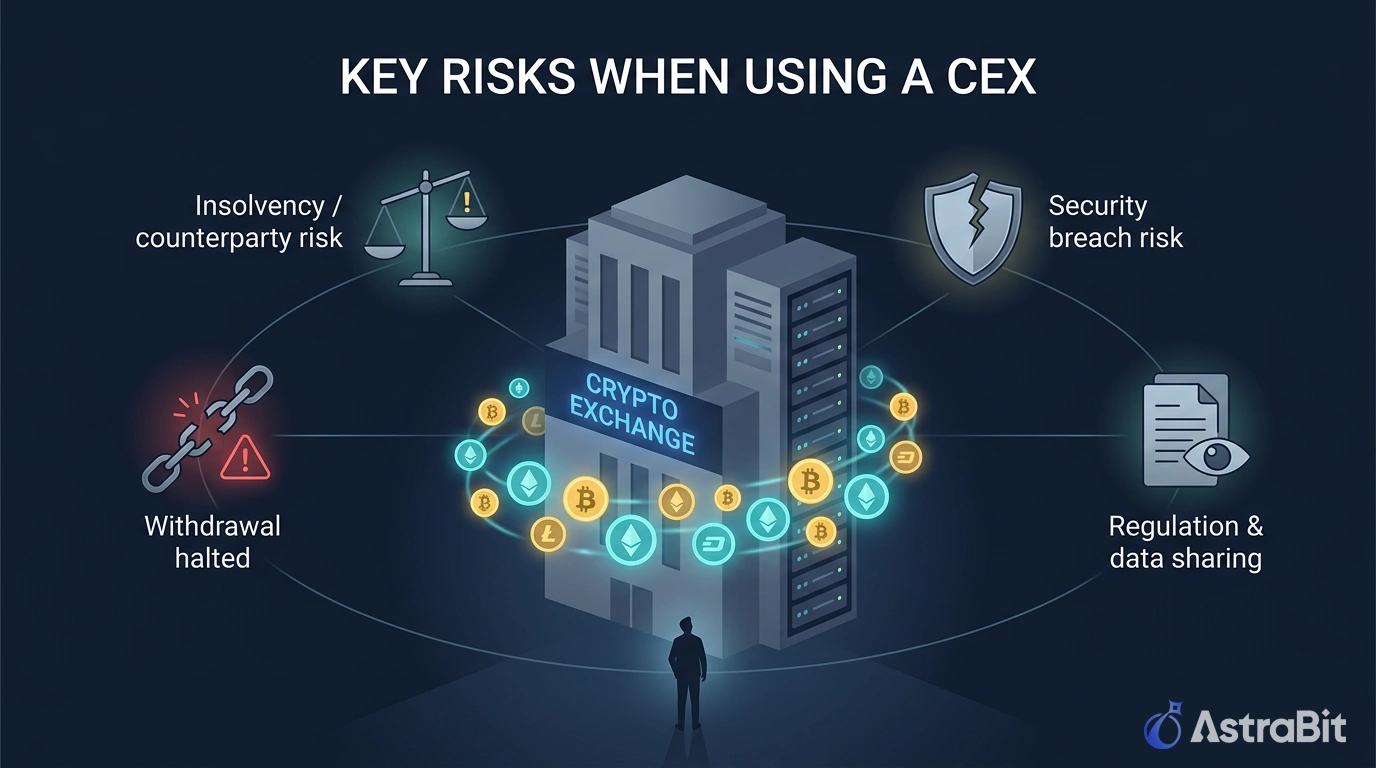
Counterparty and Insolvency risk
When you leave assets on a centralized exchange, you rely on that entity to remain solvent and to manage funds appropriately. Poor risk management, misuse of customer assets, or losses from security incidents can lead to situations where users cannot fully withdraw what they believe they own.
Operational and Security risk
Centralized exchanges are often targets for cyberattacks and must manage complex infrastructure. Security breaches, system misconfigurations, or internal fraud can affect access to balances or the integrity of account data. Even with strong controls, these risks cannot be fully eliminated.
Withdrawal and Access Risk
Exchanges can:
- Temporarily or permanently halt withdrawals for specific assets
- Impose new limits or requirements
- Restrict access for certain countries or customer segments
These decisions may arise from technical issues, liquidity constraints, or regulatory instructions and can affect your ability to move funds when you want to.
Market‑structure and Outage Risk
During high‑volatility periods, CEXs may experience:
- Slower performance or full outages
- Order‑book dislocations
- Delays in order execution or cancellation
If you cannot access your account or adjust positions during these windows, your risk exposure may change in ways you did not intend.
Regulatory and Privacy Considerations
Because centralized exchanges operate under local rules:
- They generally perform identity verification and compliance checks such as KYC/AML.
- They may share data with regulators or law‑enforcement agencies in accordance with applicable laws.
- Tax reporting obligations may arise from your activity, and some exchanges provide statements or reports that feed into those processes.
Users should understand how an exchange handles data, reporting, and regulatory requests in their jurisdiction.
Is a CEX Right for You?
Before deciding how to use a centralized exchange, you might ask yourself:
- How comfortable am I with a third party holding my assets?
- Do I understand the exchange’s policies on withdrawals, supported countries, and identity verification?
- How much of my total holdings am I willing to keep on any single platform?
- Am I planning to trade actively, or mainly to move between fiat and long‑term holdings?
This framework is educational only. For guidance specific to your situation, it can be helpful to speak with qualified professionals who understand your circumstances and local regulations.
FAQs
Do centralized exchanges own my coins?
No. Your account balance reflects a claim on the exchange’s aggregate holdings of assets, but the exchange controls the wallets that actually hold those assets. If the exchange fails or mismanages funds, your ability to recover everything you expect may be at risk.
Why do I have to complete identity verification?
Most CEXs are required to follow financial‑crime rules and consumer‑protection laws. Identity verification and compliance checks such as KYC/AML help them meet these obligations, but they also mean your activity may be monitored and, in some cases, reported.
Can I trade on a CEX without moving coins on‑chain every time?
Yes. Once your funds are deposited, trades are recorded on the exchange’s internal ledger; only deposits and withdrawals move assets on or off the blockchain.
What happens if a CEX is hacked or goes bankrupt?
Outcomes vary by jurisdiction and platform. In some cases, users may recover part of their assets after legal processes; in others, losses can be significant. There is no universal guarantee.
Are fees higher or lower than on a DEX?
Fee structures differ. CEXs typically charge maker/taker fees and may have separate deposit or withdrawal fees. DEXs charge protocol and network fees. The “cheaper” option depends on trade size, products used, and market conditions.
Key Terms Glossary
- Centralized exchange (CEX) – A company‑run platform where users trade crypto through accounts on the exchange’s internal systems.
- Custodial wallet – A wallet where a third party (such as a CEX) holds and controls the private keys on your behalf.
- Order book – A list of buy and sell orders for a trading pair, used by the exchange’s matching engine to execute trades.
- Maker/taker fees – A fee structure where “makers” add liquidity by placing limit orders and “takers” remove liquidity by matching against existing orders.
- Margin trading – Borrowing funds from the exchange or its pool of lenders to trade with leverage, subject to margin requirements and liquidation risk.
- Cold storage – Keeping private keys offline to reduce exposure to online attacks.
Related Concepts
To understand how centralized exchanges fit into crypto markets, it can be useful to read:
- What Is a Decentralized Exchange (DEX)?
- CEX vs DEX: Key Differences
- What Is Cryptocurrency? A Beginner’s Guide
- What Is Custody in Crypto?
These topics help connect CEX concepts to the broader landscape of digital‑asset trading and on‑chain activity.
Disclosure
This material is provided for educational and informational purposes only and is not intended to promote or recommend any specific product, service, platform, or strategy. The information contained herein is provided “as is,” without any representations or warranties of any kind, express or implied, including without limitation any warranty as to accuracy, completeness, timeliness, or materiality. Nothing in this material should be construed as financial, investment, legal, tax, or other professional advice, and you should not rely solely on it when making decisions. Some or all of the content, including any edits or revisions, may have been generated or assisted by artificial intelligence tools and may contain errors or omissions. The authors and publishers of this material disclaim any and all liability arising from the use of or reliance on this information.